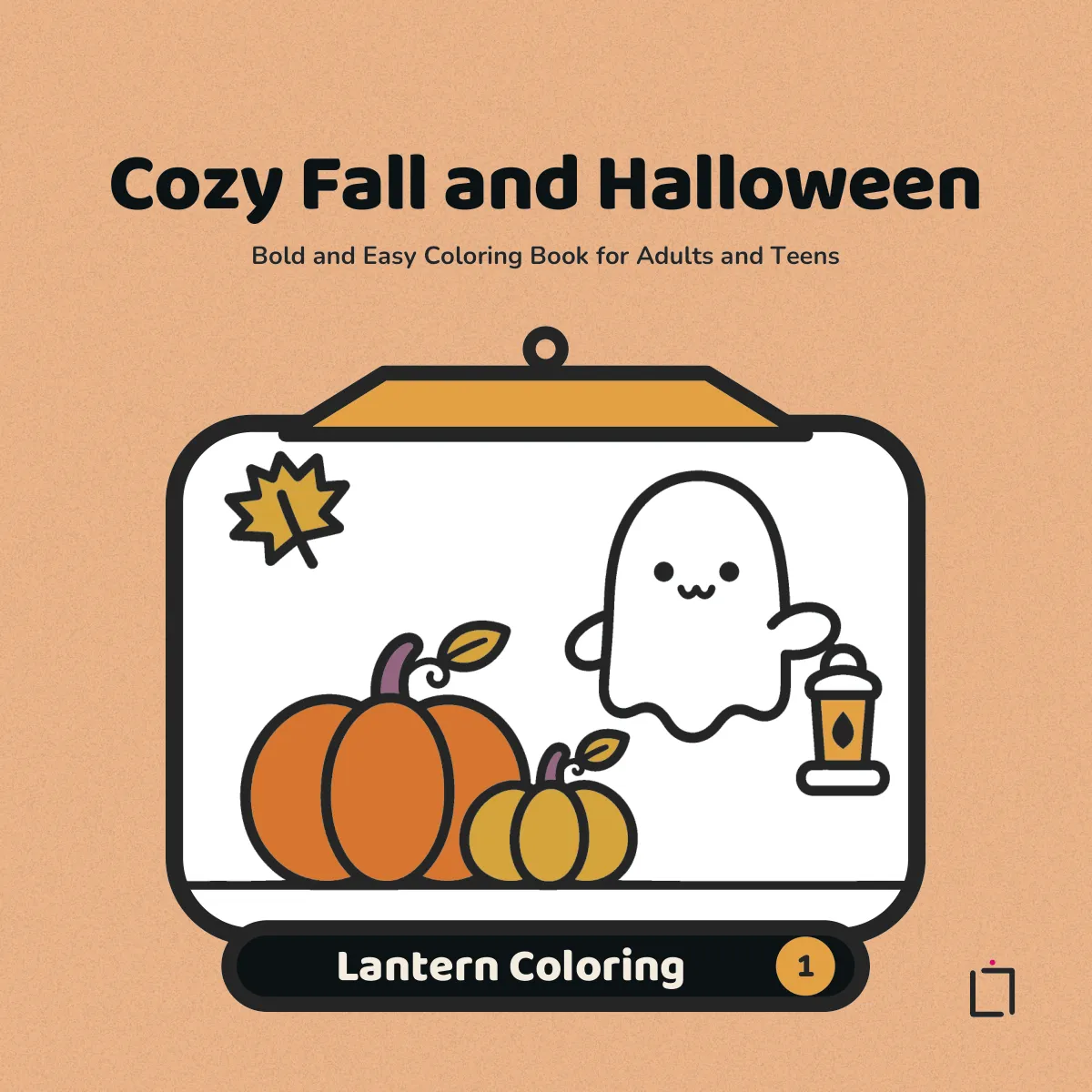
A bold and easy page is a few big spaces inside thick lines, and that changes which marker does the job. The nib, the ink, the paint markers and the budget sets, judged by what the page asks of them.
What a bold and easy page asks of a marker
The best markers for bold and easy coloring books are the ones that suit what such a page is: a handful of large shapes inside thick black lines. A mug, a pumpkin, a cat on a chair. There are few small pieces and a lot of open space, which is the whole point: the page can be finished in an evening. What is a bold and easy coloring book? says what to check for before you buy one.
That shape changes which marker suits the page. An intricate mandala asks a marker for precision: a fine point that can get into a gap two millimetres wide. A bold and easy page asks for the opposite most of the time. It asks a marker to cover a space the size of a playing card in one even color, without stripes where one stroke dried before the next, and without soaking through to the page behind.
So the questions that matter are four. How wide is the nib? What is the ink: alcohol, water, or paint? How does it behave on the paper of the book you have? And what does a cheap set give up against a dear one? None of these has a single winner. Each has a better and a worse fit for big spaces, and the rest of this guide goes through them in that order.
Nib shape and size
Markers for coloring come with a few nib shapes, often two on one marker, one at each end.
Brush. A flexible tip shaped like a paintbrush. Pressed lightly it draws a thin line; pressed down it lays a wide stroke. Copic’s Sketch and Ciao markers pair a brush with a chisel (Copic), and so does Ohuhu’s Honolulu set (Ohuhu). On a big space a brush lets you change width as you go: broad strokes across the middle, the tip along the edge.
Chisel. A firm, wedge-shaped tip. Its flat side lays a broad band, its edge a narrower one. Posca describes its 8 mm broad chisel, the PC-8K, as made for curves and covering large areas (Posca PC-8K). A chisel is less forgiving near a line than a brush, and quicker in the middle of a shape.
Fine and bullet. A round, firm point. Copic’s Classic marker pairs a wide tip with a fine one (Copic), and Ohuhu’s Honolulu B swaps the chisel for a fine tip (Ohuhu). Posca’s PC-5M is a medium bullet tip of 1.8 to 2.5 mm (Posca PC-5M). A fine or bullet tip is the right tool for the small parts of a page, and the slow one for a large space.
Why width matters on a big shape: streaks come from ink drying unevenly. Anna Rose, who makes coloring books, puts it plainly in her guide to big areas: if you leave tiny gaps between strokes, the paper dries unevenly, and that is when streaks appear. Her fix is long, connected strokes that slightly overlap, a juicy tip, and a soft hand (Anna Rose). A broad nib needs fewer strokes to cover the same shape, so there are fewer edges to dry before the next stroke reaches them.
For a bold and easy book, then, a marker with a broad end and a fine end covers the page. If you are choosing between two sets, choose the one whose broad end is a brush or a chisel, not a second bullet.
Alcohol-based or water-based
This is the choice that changes the most, and it has a trade at its heart: the ink that fills a big space best is the ink that goes through paper.
Alcohol-based markers carry dye in alcohol. Copic says its markers are alcohol-based and that the ink is dye ink (Copic FAQ), and Ohuhu describes its Honolulu ink as alcohol-based and drying instantly (Ohuhu). They are the markers most colorists mean when they talk about blending. Sarah Renae Clark, a coloring book author who has written a long guide to markers, says they give rich, saturated color and smooth blending, can look almost digitally colored with no streaks, and create solid blocks of color well. Her advice for blending is to work from light to dark (Sarah Renae Clark). That suits a bold and easy page: a large space blended from a pale to a deeper shade is where these pages look their best.
The cost is bleed. The same guide says alcohol markers are almost guaranteed to bleed through paper, and that a spare sheet underneath protects what is below but will not save the back of the page you are coloring (Sarah Renae Clark). So alcohol markers belong in a book whose pages are printed on one side, with a sheet behind the page. Why markers bleed through a coloring book, and what stops it goes through the fixes in order.
Water-based markers carry the color in water. They usually do not bleed through in the same way, though thin paper still struggles, and they are generally more affordable. The catch is on exactly the kind of space a bold and easy page is made of: they are more likely to streak, tear the paper or leave patchy coverage, particularly over larger areas, and they do not blend into each other on dry paper the way alcohol inks do (Sarah Renae Clark). For a double-sided book, the same guide recommends water-based markers.
The short version: alcohol for even, blended fills on single-sided pages, with a sheet behind; water-based where the back of the page matters, with the expectation of some texture across a large shape.
Paint markers for the last touches
Paint markers are a third kind. Posca’s are water-based, with opaque pigment colors that can be layered (Posca PC-5M). Opaque means the color covers what is under it, so a light color can go over a dark one.
That makes a paint marker a finishing tool on a bold and easy page rather than the main set. A white highlight on a gumdrop, dots on a scarf, a light color over a dark one where an alcohol marker could not go. Posca does make broad tips for large areas (Posca PC-8K), so nothing stops you coloring a whole page with them.
Paint markers ask a little more of you before the first stroke. Posca’s instructions are to shake the marker with the cap on, then press the tip on a spare piece of paper several times until it fills with paint, and test the flow there before you start (Posca instructions). The test page at the front of a book is a good place for that.
What to expect from a budget set
If you are starting with an inexpensive set, a bold and easy page is a kind place to start it, because the page asks for a few colors well laid rather than three hundred shades.
Among the alcohol sets, Ohuhu’s Honolulu markers have a brush and a chisel, and it sells replacement brush tips for when the originals wear out (Ohuhu). Sarah Renae Clark names Ohuhu’s Honolulu B as her top alcohol pick, for smooth blending and a large color range, and calls Crayola’s Super Tips the best value for money (Sarah Renae Clark). Crayola describes its Super Tips as drawing both thick and thin lines, says they are for kids or adults to use in coloring books, and says they will not bleed through paper (Crayola). That last claim is the maker’s; the paper of the book you use still decides what happens.
What a cheaper set tends to give up is worth knowing too. Sarah Renae Clark writes that cheap alcohol markers often come with lower quality tips and inks, and that the ones she tried did not live up to the more expensive brands. At the other end, she names Copic as a professional brand with a higher price tag, and Copic markers are refillable with replaceable nibs (Copic FAQ): a marker that is kept rather than replaced.
A fair plan for a first set, then: a budget alcohol set with brush and chisel ends if your book is single sided and you want to blend, or a good water-based set if the back of the page matters or you would rather not deal with bleed at all. Either fills a bold and easy page. The colors you put together matter as much as the marker, and color palettes for cozy coloring has twelve that work on these pages.
A short checklist before you buy
- A broad end. A brush or a chisel at one end of every marker, for the big spaces.
- A fine end. For the small shapes and the edges near a line.
- The ink against the book. Alcohol for blending on single-sided pages, water-based for double-sided books or a lighter touch on the paper.
- A sheet behind the page. With alcohol markers, in any book.
- A test first. Every marker, once, on a spare page or the inside cover, before it touches a design.
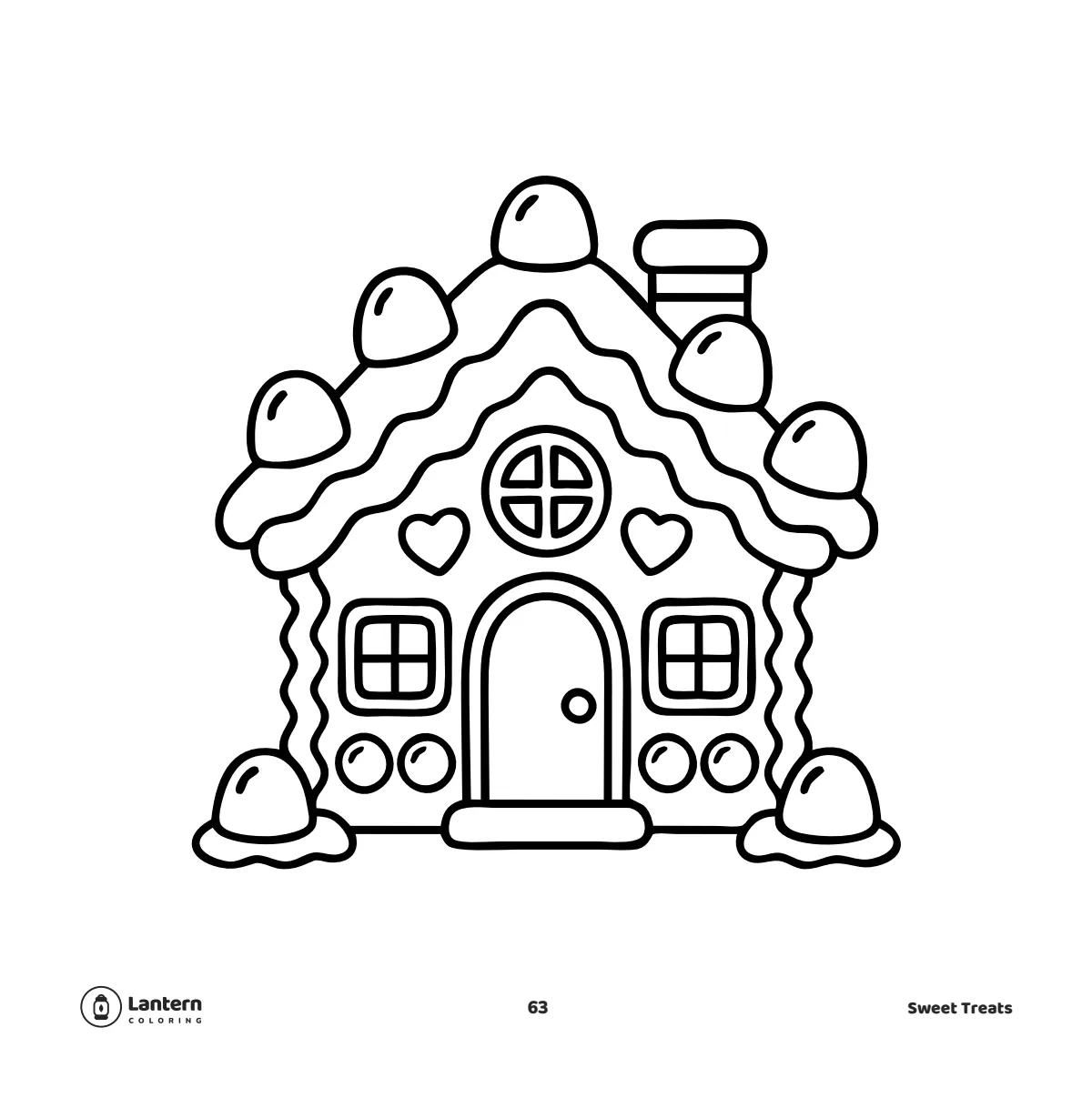
Every Lantern Coloring book has a test page at the front for the last point, and every design on a right-hand page with the back left blank. The paper is Amazon’s standard paperback paper, so the sheet behind the page is still worth slipping in when you color with alcohol markers. Sweet Treats, where the gingerbread house above comes from, is one of six.
Sources
- Copic (Too Corporation Americas). Copic Markers. The tips of the Sketch and Ciao (brush and chisel) and the Classic (wide and fine), and replaceable nibs.
- Copic (Too Corporation Americas). FAQ. Copic markers are alcohol-based with dye ink, refillable, with replaceable nibs.
- Ohuhu. Honolulu 48 Colors Dual Tips Alcohol Art Markers. Alcohol-based ink that dries instantly; brush and chisel tips, brush and fine on Honolulu B; replacement brush tips.
- Posca. PC-8K. The 8 mm broad chisel tip, for curves and large areas; water-based, opaque.
- Posca. PC-5M. The 1.8 to 2.5 mm bullet tip; water-based, opaque pigment, layerable.
- Posca. Instructions. Shake with the cap on, prime the tip on spare paper, test the flow.
- Crayola. Washable Super Tips Markers, 50 Count. Thick and thin lines, for coloring books, and the maker’s statement that they will not bleed through paper.
- Sarah Renae Clark. Beginner’s guide to markers. Alcohol against water-based markers: bleed, streaks over large areas, blending light to dark, budget sets, her picks.
- Anna Rose. How to Color Big Areas Without Leaving Streaks. Streaks from gaps between strokes, and long overlapping strokes with a juicy tip.