Coloring does not start with coloring. It starts with a scribble made from the shoulder, and a page colored on purpose comes two years later. The stages, by age, with what a coloring page can ask of a child at each one.
The answer in ages
When do toddlers start coloring? Most start making marks with a crayon in the second year, but making marks and coloring a picture are different things, and two years apart. The stages below are ranges drawn from Zero to Three, the American Academy of Pediatrics and an NHS occupational therapy service. A child can be ahead of them or behind and still be entirely typical.
From about 15 months: the scribble
The first stage is the scribble. Zero to Three, the early childhood organisation, places it from about 15 months to two and a half years: big marks made by moving the whole arm from the shoulder, with the crayon held in a fist (Zero to Three). The NHS leaflet calls this the fisted grip, and describes children holding the writing tool like a dagger and scribbling with the whole arm (Aneurin Bevan University Health Board).
At this stage the line on a coloring page means nothing to the child. They are not ignoring it; they are not looking for it. What helps is a big sheet of paper taped to the table, a chunky crayon that a fist can hold without snapping it, and a grown-up who admires the marks.
From about 2 to 3 years: controlled marks
Between two and three the scribble gets more controlled as the muscles of the hand and fingers develop. Zero to Three describes repeated marks on the page: open circles and diagonal, curved, horizontal and vertical lines (Zero to Three). The grip changes too. The NHS leaflet describes the next stage, in which all the fingers hold the crayon but the palm faces down towards the page, and the movement now comes mostly from the elbow; children start to copy a horizontal, a vertical and a circular line (Aneurin Bevan University Health Board).
A coloring page starts to make sense here, as long as it asks very little: one big shape, one or two spaces, and no expectation of staying inside anything.
About 3 to 4 years: coloring a picture
This is when most children start to color a thing rather than the paper. The American Academy of Pediatrics says that by three a child can move the fingers independently and hold a crayon like an adult, thumb on one side and fingers on the other, and can copy a circle or scribble freely (HealthyChildren). The NHS leaflet describes a four-finger grip moving into a three-finger one, with the movement coming from the wrist rather than the elbow (Aneurin Bevan University Health Board).
Now the outline matters. A child at this stage looks for the edge of the duck and tries to fill it, and the book decides whether they can: a line thick enough to find, and spaces wide enough for the crayon they actually hold. Staying inside comes slowly, and coloring inside the lines is about when it comes and why it should not be asked for.
About 4 to 6 years: planning the page
From four, children start to decide in advance what they want to make. The American Academy of Pediatrics describes four year olds who decide what to create and then create it (HealthyChildren). In coloring that looks like choosing colors for a reason, a pink pig, a blue sky, and keeping to a space on purpose. Pages with a little more in them become a pleasure instead of a frustration, and a three-finger grip settles in. The NHS leaflet says most children master that grip by the age of six or seven (Aneurin Bevan University Health Board).
The grip, and what not to correct
A three year old holding a crayon in a fist is not doing it wrong. Each grip is a stage, and the NHS leaflet is explicit that there is no need to worry if a child is not holding a pencil properly as they start school, because most master it by six or seven. It also says that chunkier writing tools may help young children who move the pencil with the whole arm (Aneurin Bevan University Health Board).
What helps the grip more than correcting it is play that builds the hand: pinching playdough, threading big beads, using pegs, painting at an easel. The same leaflet lists all of these. Coloring with a chunky crayon on big spaces is one more.
Holding a pencil for letters is the next step, and it belongs with writing: how to teach a preschooler to write letters starts with the grip.
When to ask
The ranges are wide, and a child who scribbles at three and a half is within them. If anything about how your child uses their hands worries you, ask your health visitor or doctor rather than a guide; they can see the child. Scholastic’s parenting advice gives one marker for coloring itself: a child who still cannot color inside the lines in first grade is worth mentioning to the teacher and the pediatrician, in case a vision test or another check is needed (Scholastic).
If you want one of ours
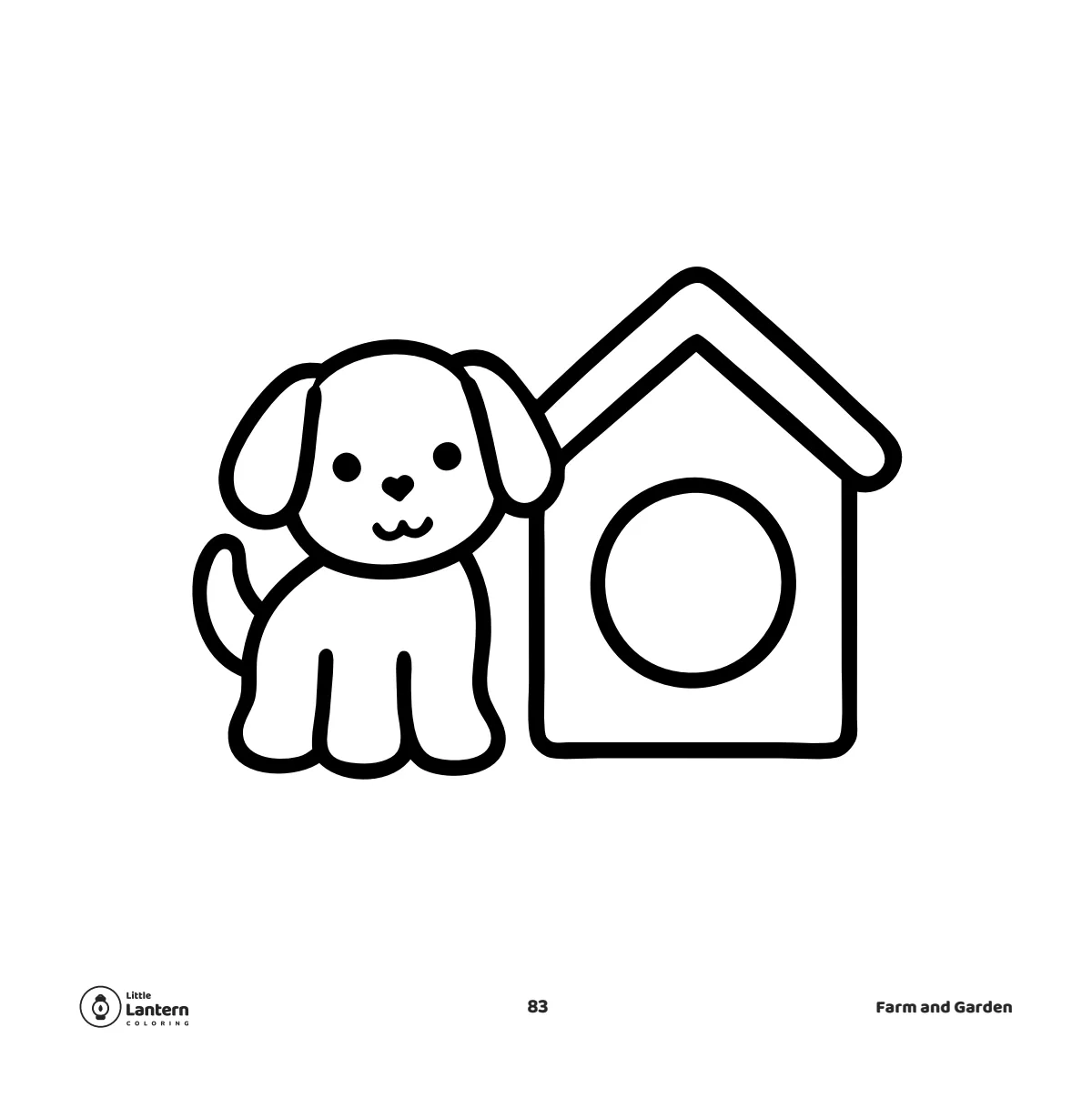
This part is about our own books, so weigh it accordingly. Little Lantern Coloring is drawn for the stage from about three, when coloring a picture starts: one big subject on every page, every outline at least 1.8 mm thick, and no space narrower than about a centimetre, the width of a jumbo crayon, so a child still using a fist can fill every one. Farm and Garden is the first volume, for ages 3 to 6, and goes on sale in November; the puppy above is from it.
Sources
- Zero to Three. Learning to write and draw, 24 February 2017. Scribbling from about 15 months to 2½ years from the shoulder with the crayon in a fist; more controlled marks from 2 to 3; the move to holding the crayon between thumb and finger; notice the process, not just the product.
- American Academy of Pediatrics, HealthyChildren.org. Hand and finger skills of your preschooler, updated 28 July 2022. At three a child can hold a crayon like an adult and copy a circle; at four they decide in advance what to create.
- Aneurin Bevan University Health Board, Occupational Therapy Service for Children and Young People. Development of a tripod pencil grip. The stages from a fisted grip to a dynamic tripod; chunkier tools may help; most children master the tripod grip by 6 or 7.
- Kelsey Kloss, Scholastic Parents. That magical moment your preschooler starts coloring inside the lines, 14 December 2018. If a child cannot color inside the lines in first grade, talk to the teacher and pediatrician.