Staying inside the lines is a milestone, not a rule. It comes on its own between three and five, it is made of several skills at once, and asking for it tends to slow it down. When to expect it, what helps, and when to ask someone.
When it comes
When do kids color inside the lines? Usually somewhere between three and five. Scholastic’s parenting writers place it among the milestones children tend to reach between three and five years of age (Scholastic), and that matches what the hand is doing at the time. By three many children can hold a crayon like an adult, thumb on one side and fingers on the other (HealthyChildren), but holding it that way and steering it into a corner are years apart.
Before that, a toddler scribbling across the whole page is not being careless. They are at the stage where the marks themselves are the point, and when do toddlers start coloring? sets out what comes before this one.
What it is made of
Staying inside a line looks like one skill. It is at least three:
- Control of the hand. Moving the crayon from the wrist and fingers rather than the whole arm, so it goes where it is aimed.
- Seeing the shape. Understanding that the line is an edge, that the duck ends there and the page begins.
- Holding back. Choosing to slow down near the edge instead of finishing the stroke.
Scholastic names the same things: fine motor skill, a growing sense of space and boundaries, cause and effect, and self-control (Scholastic). They grow at different speeds, which is why a child can stay inside on one day and not on the next.
Do not ask for it
The advice is plain. Scholastic reports that experts advise against explicitly asking children to color within the lines, and against correcting the way a child colors; praise the effort instead (Scholastic). Zero to Three makes the same point about drawing in general: notice the process, not just the product, because children learn more when the focus is not on what they have made (Zero to Three).
A child told that the page is wrong learns that coloring is a test. A child told that they chose a lovely blue, or that they worked hard on the duck, comes back to the page tomorrow, and the control comes with practice.
What helps instead
The page can do most of the work.
- A line thick enough to find. A thin outline disappears under the first pass of wax, and then there is no edge to stay inside. A heavy one stays visible and gives the crayon something to stop against.
- Spaces bigger than the crayon. A space narrower than a chunky crayon cannot be colored inside, by anyone. Big spaces let a child fill the middle freely and creep towards the edge when they are ready.
- One space at a time. Coloring the body of the duck, then its wing, rather than the whole picture at once, makes each edge a small target.
- Fewer things on the page. One big subject has a handful of edges; a scene has hundreds.
- The child’s own pace. Slow is not better or worse. Some children color the edge first and fill in after; some fill and then neaten. Both work.
Outside the lines is fine too
A page colored right over the lines is still a page colored, and a child who wants to give the cow a purple sky behind it is making a choice. Blank paper, big crayons and no outline at all are as good for the hand as any coloring book. The book is one thing among many, and it is not a test.
When to ask someone
A child who scribbles across the lines at three, or at four, is within the normal range. Scholastic suggests talking to the teacher and the pediatrician if a child still cannot color inside the lines once they reach first grade, in case a vision test or another assessment is needed (Scholastic). Before then, if anything about how your child uses their hands worries you, ask your health visitor or doctor; that is what they are there for.
If you want one of ours
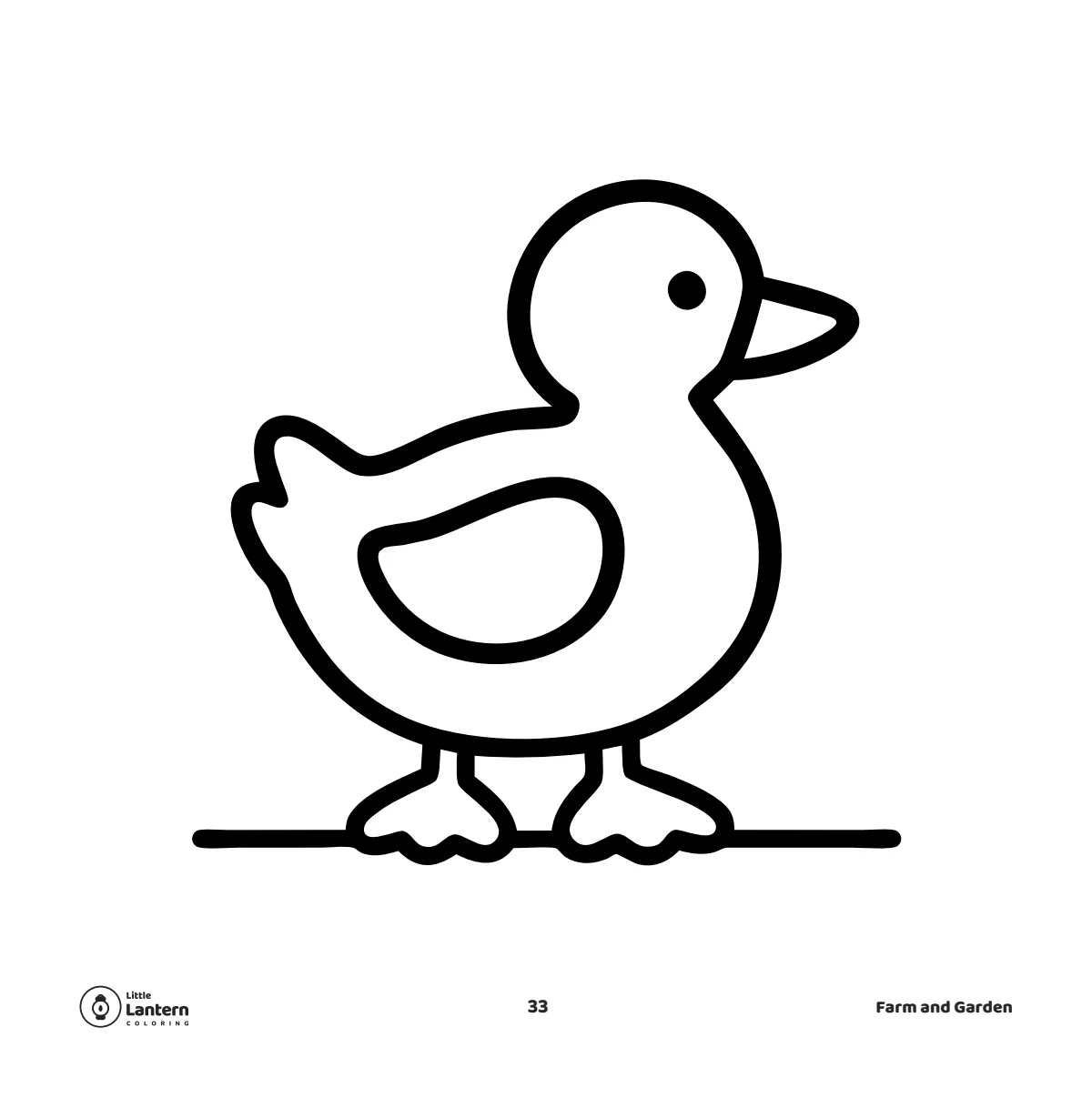
This part is about our own books, so weigh it accordingly. Little Lantern Coloring is drawn so that staying inside is possible at three without being asked for: every outline at least 5 points, about 1.8 mm, no space narrower than about a centimetre, and never more than eleven spaces on a page. Farm and Garden, the first volume, goes on sale in November; the duck above is from it. For what to look for in any book, how to choose a coloring book for a 3 year old has the five checks.
Sources
- Kelsey Kloss, Scholastic Parents. That magical moment your preschooler starts coloring inside the lines, 14 December 2018. A milestone between three and five; fine motor, spatial skills, cause and effect and self-control; experts advise against asking children to color within the lines or correcting them; talk to the teacher and pediatrician if it has not come by first grade.
- Zero to Three. Learning to write and draw, 24 February 2017. Notice the process, not just the product.
- American Academy of Pediatrics, HealthyChildren.org. Hand and finger skills of your preschooler, updated 28 July 2022. At three a child can hold a crayon like an adult, thumb on one side and fingers on the other.