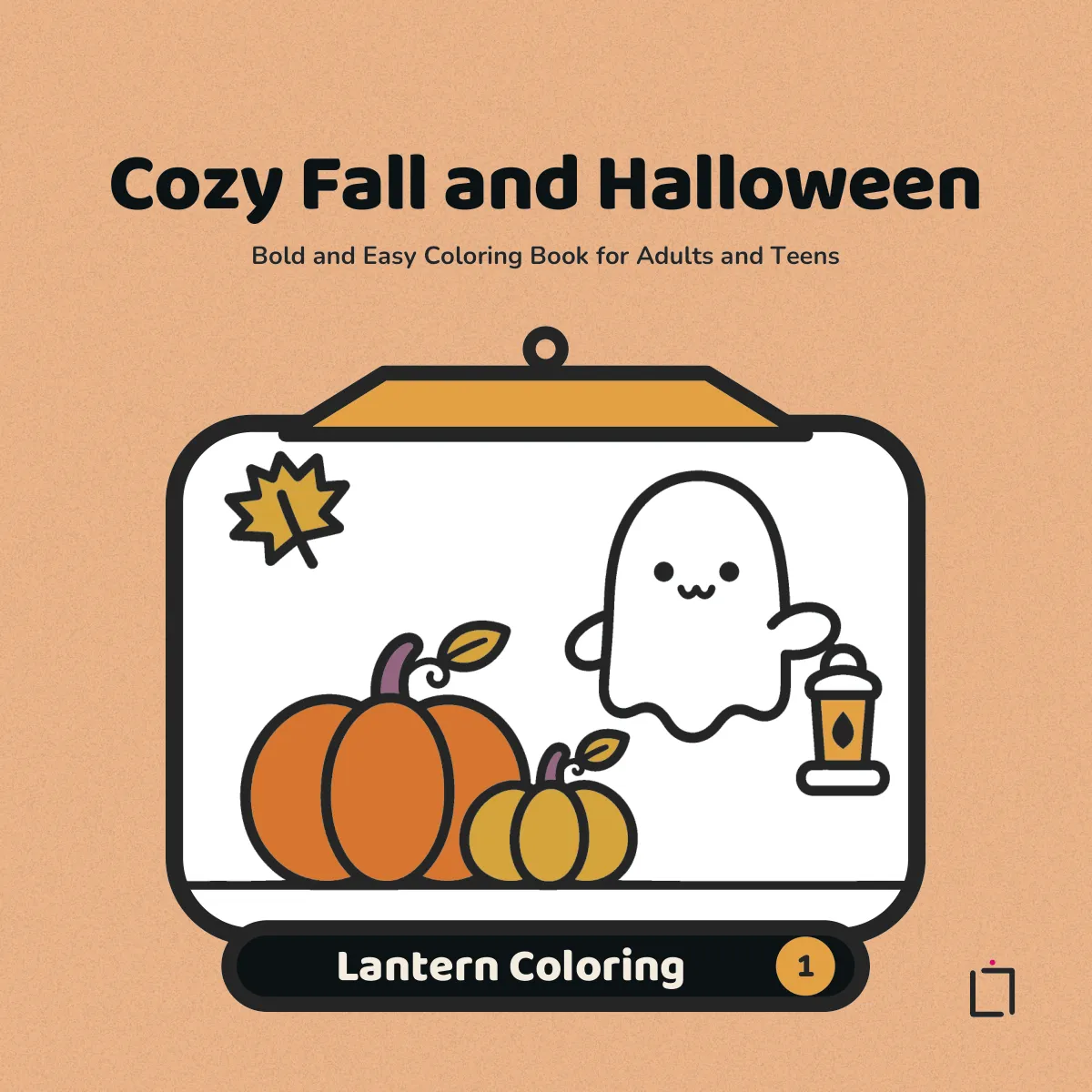
The words are a format, not a guarantee, and any cover can carry them. Here is what they should mean, as six things you can check in the preview before you pay, and how to use them to choose a coloring book for an adult.
What the words mean
“Bold” is the line. “Easy” is the space between the lines. A bold and easy coloring book is drawn with thick, even outlines around shapes big enough to fill without care, so that a page can be started and finished in one evening, with markers as well as pencils.
That is the whole idea, and it is the opposite of the intricate book: the mandala or the kitchen with forty jars, beautiful on the cover and easy to abandon on page twelve. A bold and easy page is not meant to be dull. It is meant to be finished, and to leave room for the color itself to be the interesting part: a blend, a palette, a clean edge.
The trouble is that the words are a format, not a promise anyone checks. Any book can say “bold and easy” on the cover. So the useful question is not what the phrase means but what a book has to do to deserve it. Six things, and every one of them can be seen in the preview before you buy.
Line weight you can see at a glance
The first check is the outline itself. In a bold book the line is thick enough to read from across the room and the same weight all the way round. A thick line does two jobs. It hides a wobble: if your marker strays a little, it strays onto black. And it gives the page its shape after it is colored, so a light fill still looks finished.
What to look for in the preview: lines that stay thick in the small parts of the picture too, not a bold outline around a finely drawn middle. A page with a heavy border and thin, sketchy detail inside is an intricate page in a bold frame.
Open space: no shape too small to fill
The second check is the size of the smallest space. Look at the busiest page you can find in the preview and ask whether every closed shape on it would take a broad marker nib without touching the line. If a shape is smaller than your fingertip, it is detail, and detail is what “easy” is supposed to leave out.
Two smaller checks go with it. Every line should close, so a fill stops where the shape stops. And there should be white space around the picture, not texture filling every gap: wood grain on every plank and a pattern on every cushion turns a simple room into an intricate one.
One subject to a page
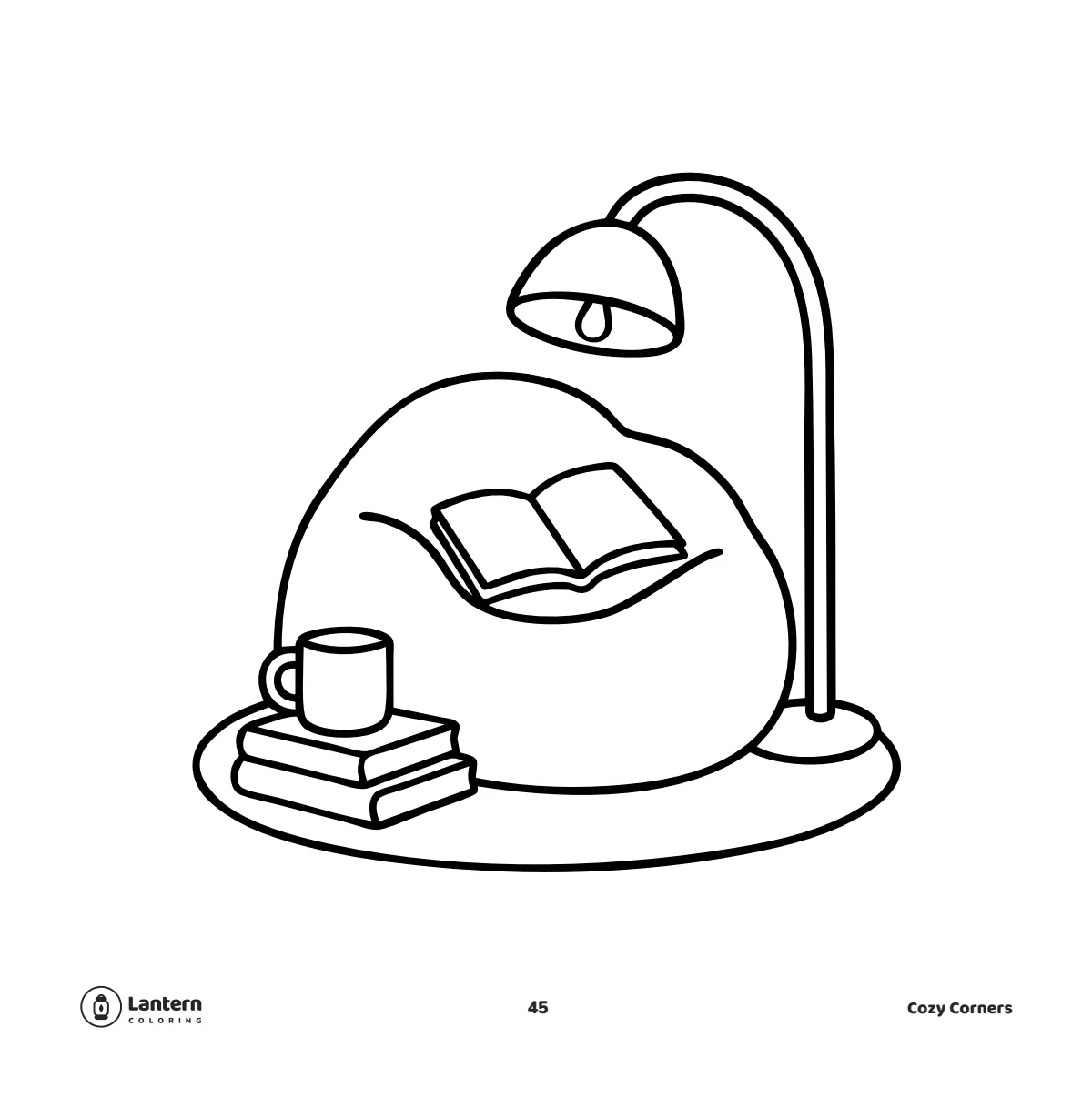
The third check is what the page is of. A bold and easy page has one subject: a mug, a penguin, a reading chair with a lamp. A fuller page may put a few things together, a chair and a rug and a stack of books, but they are one scene with one center, not a crowd. When a page tries to hold a whole street, the shapes have to shrink to fit, and the second check fails with it.
Single-sided pages
The fourth check is the back of the page. Alcohol markers soak through ordinary paper. Altenew, which sells them, says plainly that they tend to bleed and are not recommended for double-sided coloring books (Altenew), and the colorist and publisher Thaneeya McArdle says the same of her own experience, adding that her books avoid the problem by being single sided (Art Is Fun).
A single-sided book prints each design on one side of the sheet and leaves the back blank. A marker that soaks through then spoils nothing. If the listing does not say “single sided”, assume it is not. Single sided does not mean the paper stops ink: a sheet of scrap paper behind the page you are coloring still keeps the next page clean. Why markers bleed through a coloring book, and what stops it goes through the fixes in order, and the best markers for bold and easy coloring books is about which nibs suit big spaces.
A note on paper, because listings blur it. A paperback printed through Amazon KDP uses its standard paper, which KDP lists for black ink paperbacks at 50 to 61 pound, 74 to 90 GSM (Amazon KDP). That is ordinary book paper, not marker paper, whatever the description says. Single-sided printing is what makes it work with markers, not the paper.
Designs, not pages
The fifth check is the count. A single-sided book has about twice as many pages as designs, because every design has a blank page behind it. So “110 pages” and “52 designs” can describe the same book, and a listing that gives only the page count is telling you less than it seems.
Count designs, then check what counts as one. A full design fills the page. Watch for quarter-page pictures, the same drawing twice with a different border, and a scene repeated from the same publisher’s other books. A preview that shows enough pages, or a contact sheet of every design, lets you see whether the designs are whole and different from each other.
An effort order you can see
The sixth check is the hardest to see from a cover and the one that decides whether you finish the book. The cover says easy; is the middle of the book easy too? A good bold and easy book knows how much effort each page asks and puts them in an order you can rely on: quick single objects first, a few fuller scenes in the middle, quiet pages at the end.
What to look for: a preview from the middle of the book, not only the first three pages. If the busiest page in the book still passes the second check, the whole book is bold and easy. If the publisher tells you how the book runs, front to back, that is a good sign they planned it.
How to choose a coloring book for adults
With the six checks in hand, choosing comes down to a few honest questions about the person who will color it.
What will they color with? If the answer is alcohol markers, single sided is a requirement, not a feature, and a scrap sheet behind the page is still wise. If it is colored pencils, a single-sided book matters less, and a slightly fuller page can suit them. If you do not know, choose single sided: it costs nothing when pencils are used and saves the book when markers are.
How long is an evening? Someone who colors for twenty minutes before bed wants pages that end in twenty minutes: single objects, big spaces. Someone who colors for an afternoon may enjoy fuller scenes. A book with an effort order serves both, because you can pick the page to fit the time.
Do they want a subject or a season? A season is a reason to color, and it also dates a book. A Christmas book is perfect in December and waits in a drawer until the next one. A book with no season in it, a cozy room, a bakery counter, animals, works in any month.
How big is the page? Check the trim size in the listing. A smaller page makes every shape smaller, which works against the second check. A larger one is harder to hold on a sofa.
Can you see inside? Buy only what you can preview, and look at the middle of the book. Plaid, a craft supplies company, gives one piece of advice for new colorists that holds for experienced ones too: be selective, and buy books one at a time, because styles differ and you will find you prefer some (Plaid). And test markers on a page at the back of the book before you start on a design (Plaid): a good book gives you a page for it.
If you are choosing for someone else, coloring book gifts for adults turns these questions into a checklist, including how to avoid giving the book they already have.
What our books do with this
The Lantern Coloring books are this press’s own, so read this part as what it is. Each volume is 52 bold and easy designs on 110 pages, 8.5 x 8.5 inches, one design to a right-hand page with the back left blank, and a page to test your pens before you start. Each one opens on single objects, moves into fuller scenes in the middle and closes on quiet pages again. They are for adults and teens 14 and up; Cute Animals is drawn for adults and kids from 7.
The paper is KDP’s standard paperback paper, not thick and not marker proof, so the single-sided pages and a sheet behind are what protect the next design. The pictures start in an image generation tool and are then checked and corrected one by one, for a line that does not close or a space too small to color; how the books are made says more.
If you want the one with no season in it, Cozy Corners is reading nooks, window seats and kitchen shelves, and the page above is from its middle. Plenty of other publishers make good bold and easy books too. Whichever you look at, the six checks are the same.
Sources
- Altenew. Water-based vs alcohol markers, 4 February 2022. Alcohol markers tend to bleed and are not recommended for double-sided coloring books.
- Thaneeya McArdle, Art Is Fun. Tips for using alcohol markers in coloring books. Alcohol marker ink tends to bleed through; single-sided books and sheets of paper underneath avoid the damage.
- Amazon KDP. Print options. The weight of KDP’s black ink paperback paper, 50 to 61 pound (74 to 90 GSM).
- Plaid. 10 tips for adult coloring book newbies, 10 December 2019. Buy coloring books one at a time; test markers on a page at the back of the book.