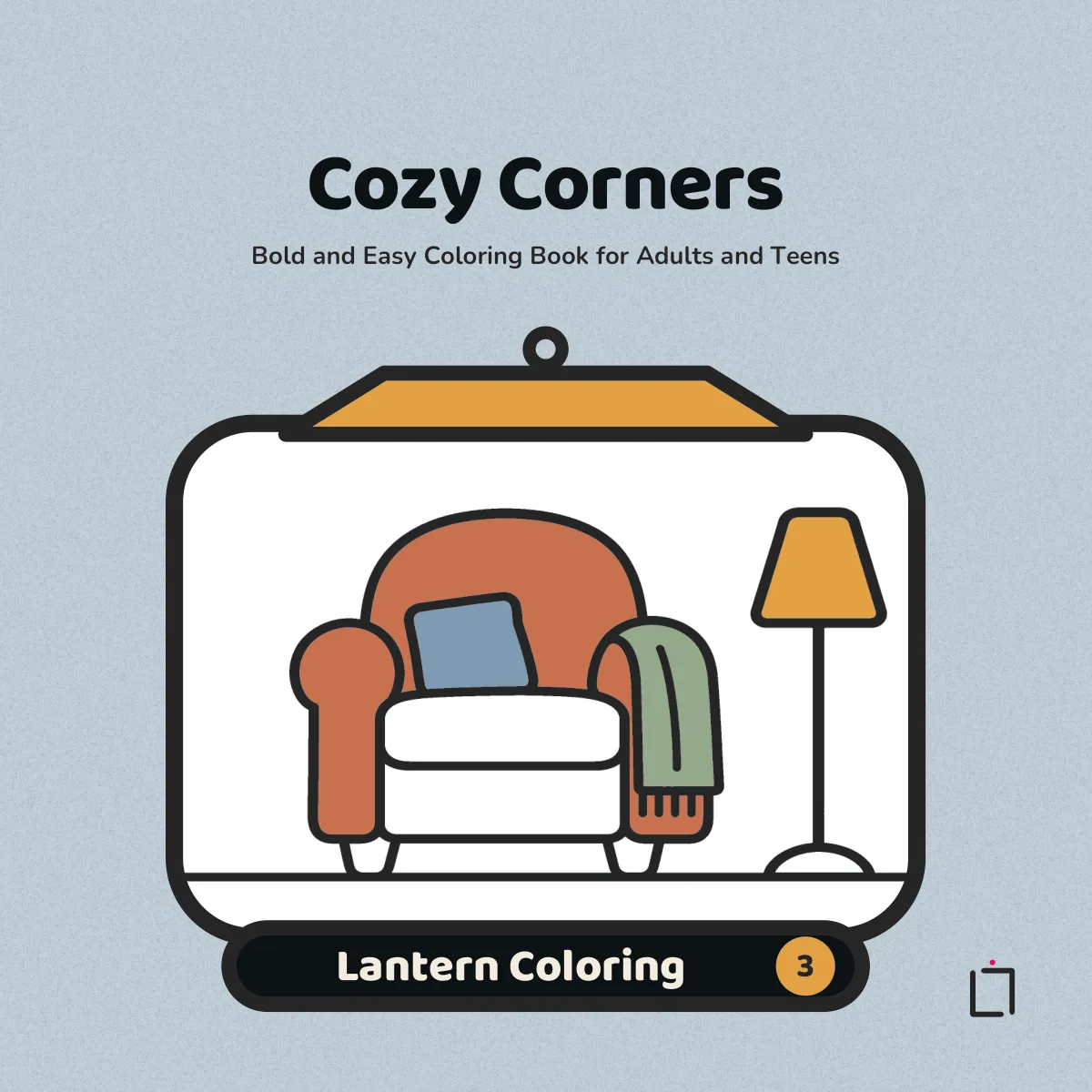
The habit is small: one page, finished, and the phone somewhere else. How to set it up, how long a page takes and why that varies, and what the research says about evening screens, about coloring and anxiety, and what it does not say about sleep.
One page, and the phone somewhere else
Coloring before bed instead of the phone is simple enough to fit in a sentence: in the last hour of the evening, color one page instead of scrolling, and stop when it is done. The habit is what does the work. A page has an end, and a feed does not. When the last space is filled, the evening has a natural place to stop, which is the thing the phone never gives you.
Two choices make it hold. The first is where the phone goes. Face down on the table next to the book is still in reach, and the first buzz pulls the evening back to the screen. Another room, on its charger, is better. The second is the size of the evening. One page you finish beats three you start, because a finished page is the reason to come back to the book tomorrow.
Setting up: light, one small set, one page
Light. You need enough light to tell a pale blue from a pale gray, so a lamp beside or behind you rather than the ceiling light alone. That is a real trade, and it is worth saying plainly: bright light in the evening is part of what the research on screens is about (below), and a lamp is light too. A lamp close to the page, with the rest of the room dimmer, gives you the colors without lighting the whole room.
One small set. Five or six markers or pencils, chosen before you sit down, and the rest of the box left closed. A big set at bedtime turns into an hour of choosing. A short list of colors that sit well together is half the calm of the page; color palettes for cozy coloring pages has twelve, and the candlelight and lavender evening palettes there are meant for late pages. With markers, slip a sheet of paper behind the page.
One page you can finish. Pick it before you sit down, the way you would pick a short chapter rather than a long one. A page with a few big spaces is a page you can finish; a full scene with forty small shapes is a weekend page. That is most of what a bold and easy coloring book is: thick lines and large spaces, so that a page fits in an evening.
A place to leave it. The book open on the table, the pens in a cup beside it. If tomorrow evening starts with the book already out, it is the book you reach for, not the phone.
How long a page takes
It varies, and nobody has measured it in a way worth quoting, so here is why rather than a number. Four things decide it:
- How many spaces the page has. A single mug with a coaster is a handful of spaces; a reading nook with shelves, books and a rug is dozens.
- What you color with. A broad marker nib covers a big space in fewer strokes than a pencil point. Pencils, layered for light and dark, take longer and give you more to do in one space.
- How much you blend. Flat color, one per space, is quick. Two colors in each space, a light and a dark, can double the work.
- How much white you leave. Snow, steam and highlights left bare are spaces you do not fill.
So time the page yourself, once or twice, and you will know your own answer. If a page runs past the hour, it is the wrong page for a weeknight, not a failed evening; keep it for Saturday.
Our books are ordered so that the choice is easy: each opens on single objects, moves into fuller scenes in the middle and ends on quiet pages again. For a weeknight, start from the front or the back.
What the evidence says, and what it does not
Screens and evening light. The NHS advises against phones, tablets and computers for an hour before bed, and says the blue light from screens can make it harder to fall asleep (NHS Every Mind Matters). In a laboratory study, people who read on a light-emitting e-reader before bed, compared with reading a printed book, took longer to fall asleep, felt less sleepy in the evening, made less melatonin, had their body clock shifted later and were less alert the next morning (Chang and colleagues, 2015). Light that is not from a screen matters too: in a study of 116 young adults, ordinary room light in the hours before bedtime, compared with dim light, delayed the evening rise of melatonin in almost everyone and shortened its nightly duration by about 90 minutes (Gooley and colleagues, 2011). Both are laboratory studies with controlled light, not homes, but they point the same way: less light, and less screen, in the last hours of the evening.
Coloring and anxiety. A few small trials link coloring with lower anxiety. In one, 104 female university students colored daily for a week or did logic puzzles instead; the coloring group’s depressive symptoms and anxiety went down and the puzzle group’s did not (Flett and colleagues, 2017). In two studies at the University of the West of England, students reported less anxiety and more mindfulness after coloring than after a control task (Holt and colleagues, 2019). The groups are small and made up of students, so they say little yet about adults in general.
What is not shown. We found no study showing that coloring before bed improves sleep. The screen studies compare a screen with a printed book, not with coloring, and the coloring studies measure mood, not sleep. So the honest claim is a narrow one: a coloring page is a way to spend the last hour without a screen, which is what health services advise, and some people find it calming while they do it. If you have trouble sleeping that lasts, that is a question for a doctor, not for a coloring book.
Three evenings a week
A routine that lasts is one you can keep on a tired night, so keep it short:
- After dinner, choose the page and the five or six colors, and leave them out.
- An hour before bed, put the phone on its charger in another room.
- Under the lamp, color the page. Big spaces first, small details last, white left where you want light.
- When it is done, put the caps back on and leave the book open on the finished page. Then stop, even if there is time for another.
Three evenings a week is plenty to start. Some evenings the phone will win, and that is fine; the book will still be open on the table tomorrow.
Choosing a book for the evening
Any book with big spaces and a page you can finish will do. Look for thick lines, one subject to a page and pages printed on one side, so a marker that soaks through spoils nothing. A book with no season in it suits every month, which is why we point evening colorists to Cozy Corners: mugs, lamps, reading nooks and window seats, 52 designs, ending on a few quiet objects. The rest of the Lantern Coloring series works the same way.
If you want to give the habit to someone else, a book and a small set of pens is the whole present; coloring book gifts for adults is about choosing one they will finish.
Sources
- NHS Every Mind Matters. Fall asleep faster and sleep better. The advice on screens in the hour before bed.
- Chang, A. M., Aeschbach, D., Duffy, J. F., and Czeisler, C. A. (2015). Evening use of light-emitting eReaders negatively affects sleep, circadian timing, and next-morning alertness. Proceedings of the National Academy of Sciences, 112(4), 1232 to 1237.
- Gooley, J. J., Chamberlain, K., Smith, K. A., Khalsa, S. B., Rajaratnam, S. M., Van Reen, E., Zeitzer, J. M., Czeisler, C. A., and Lockley, S. W. (2011). Exposure to room light before bedtime suppresses melatonin onset and shortens melatonin duration in humans. Journal of Clinical Endocrinology and Metabolism, 96(3), E463 to E472.
- Flett, J. A. M., Lie, C., Riordan, B. C., Thompson, L. M., Conner, T. S., and Hayne, H. (2017). Sharpen your pencils: preliminary evidence that adult coloring reduces depressive symptoms and anxiety. Creativity Research Journal, 29(4), 409 to 416.
- Holt, N. J., Furbert, L., and Sweetingham, E. (2019). Cognitive and affective benefits of coloring: two randomized controlled crossover studies. Art Therapy, 36(4), 200 to 208.