Almost every coloring book for small children says it builds fine motor skills. Some of that is true, some is hope, and very little of it has been tested on coloring itself. What the research says, what it does not, and how to choose a page that does the hand some good.
The short version
Is coloring good for fine motor skills? Probably, a little, in the way that most things a child does with their hands are. The research supports practising hand skills in early childhood. It does not single out coloring, and it does not show coloring is better than drawing, cutting, building or playdough. A coloring book is a fine thing to give a three year old. It is not a course.
What fine motor skills are
Fine motor skills are the small, controlled movements of the hands and fingers: picking up a pea, turning a page, doing up a button, holding a crayon and steering it. They grow in a rough order, from the shoulder and elbow outwards to the wrist and then the fingertips. An NHS occupational therapy leaflet describes that order, and the grips a child moves through on the way, from a fist at the start to a three-finger grip that most children master by six or seven (Aneurin Bevan University Health Board).
Coloring uses all of it: the arm to fill a big space, the wrist to turn, the fingers to stop at an edge. Scholastic’s parenting writers describe staying inside the lines as a sign of developing fine motor skill, along with a sense of space and self-control (Scholastic).
Why people care
Hand skills at the start of school are linked to how children do later. A 2010 study by David Grissmer and colleagues reanalysed several large longitudinal data sets and found fine motor skill at kindergarten entry to be a strong predictor of later achievement, with a similar strength to attention for mathematics (Grissmer and others, 2010).
That is a link, not a cause. It shows that children with better hand skills at five tend to do better later. It does not show that practising hand skills, or coloring, makes them do better later.
What the evidence shows
The best summary is a 2020 systematic review and meta-analysis of programmes designed to improve fine motor development in children from birth to six. Of 31 studies, 25 reported that the programme improved fine motor skills, and pooling 19 of them showed moderate effects on fine motor, visual motor and manual dexterity outcomes (Strooband and others, 2020).
The authors are careful: many of the studies had a high risk of bias, so the findings are promising but need to be read with caution (Strooband and others, 2020). The programmes also varied widely in what children did, how often and for how long. Practising with the hands helps; the review cannot say which practice helps most.
What it does not show
There is no good trial of coloring on its own. Searching for one turns up small studies, mostly with no control group, in which children colored for a few weeks and their hand skills were measured before and after. Children of four and five get better at most things in a few weeks, with or without coloring, so a study without a comparison group cannot say what caused the change.
Nothing in the research shows coloring is better for the hand than drawing, painting, cutting with safety scissors, threading beads, building with blocks or squeezing playdough. The NHS leaflet recommends that whole range for building the hand (Aneurin Bevan University Health Board).
So, is it good?
Yes, as one of several things. Coloring has two advantages over many of the others: a child can do it sitting down and mostly alone, and it ends in something finished they can show. Those are reasons enough to give a child a coloring book. They are not reasons to call it educational, and a book that promises to teach your child to write is promising more than coloring can deliver.
If you want to build the hand on purpose, mix it up: a coloring page one day, playdough the next, beads, an easel, a sticker sheet. Variety does more than any one of them.
What makes a page useful for the hand
A coloring page only exercises the hand if the child can actually color it. Three things decide that at three:
- Big spaces for the arm. A large shape to fill with broad strokes is where a young child starts.
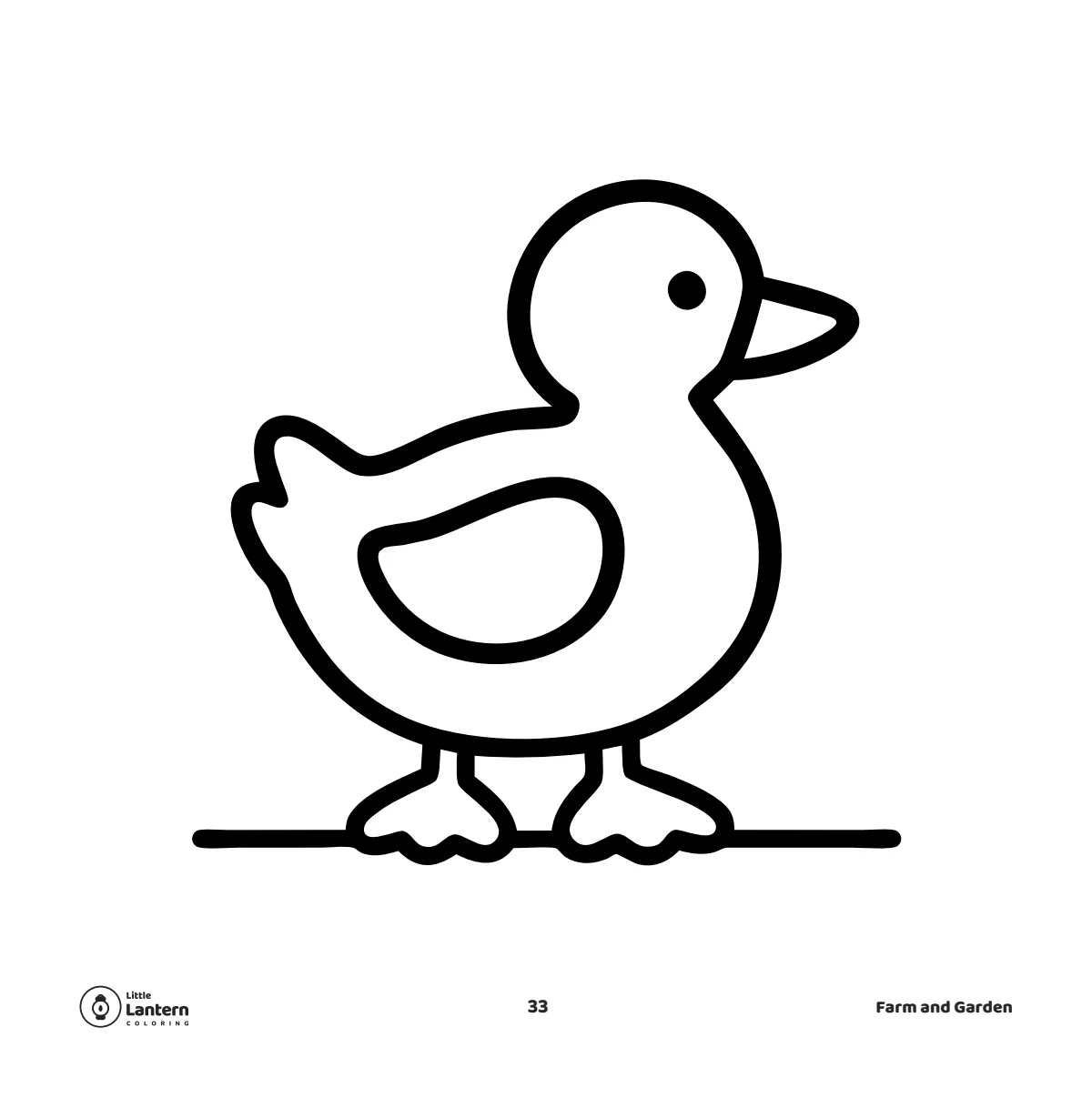
- Edges they can find. An outline thick enough to stay visible through the crayon gives the hand something to steer towards and stop at.
- Nothing too small. A space narrower than the crayon cannot be colored inside, so it teaches nothing except giving up.
A page that is too detailed for the child’s hand does less for it than a blank sheet. How to help a toddler learn to color is about setting the page up so they get going.
If you want one of ours
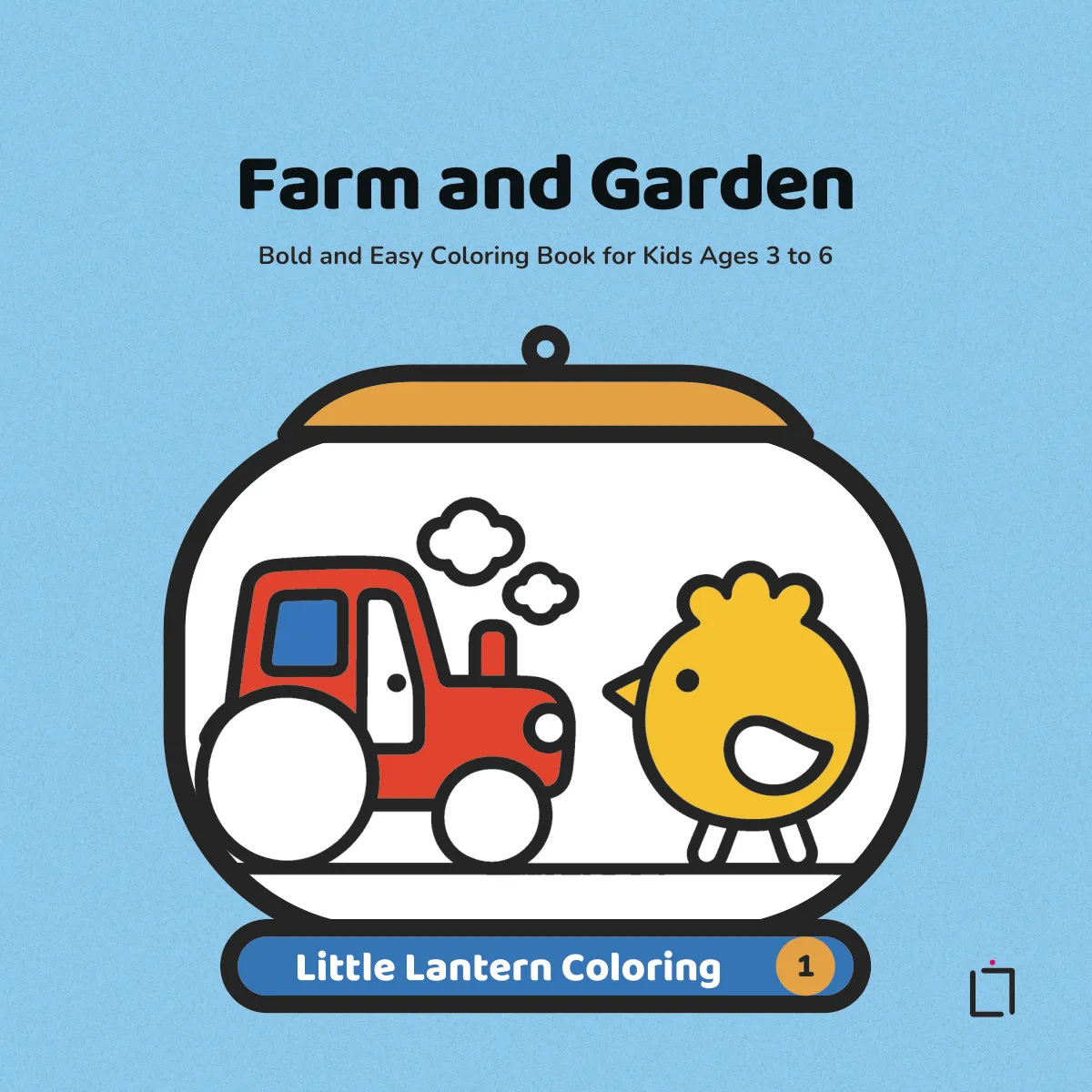
This part is about our own books, so weigh it accordingly. We do not sell Little Lantern Coloring as a lesson, and this guide is why. We draw it for the three things above: big shapes, outlines about 1.8 mm thick, and every space at least a centimetre across. Farm and Garden, the first volume, goes on sale in November; the duck above is from it.
Sources
- Strooband, K. F. B., de Rosnay, M., Okely, A. D., and Veldman, S. L. C. Systematic review and meta-analyses: motor skill interventions to improve fine motor development in children aged birth to 6 years. Journal of Developmental and Behavioral Pediatrics 41(4), 319 to 331, 2020. 25 of 31 studies reported positive effects; moderate effects across 19 pooled studies; high risk of bias in many studies, so the findings need caution.
- Grissmer, D., Grimm, K. J., Aiyer, S. M., Murrah, W. M., and Steele, J. S. Fine motor skills and early comprehension of the world: two new school readiness indicators. Developmental Psychology 46(5), 1008 to 1017, 2010. Fine motor skill at school entry is a strong predictor of later achievement.
- Aneurin Bevan University Health Board, Occupational Therapy Service for Children and Young People. Development of a tripod pencil grip. The order in which the hand develops, the grips on the way, and play that builds the hand.
- Kelsey Kloss, Scholastic Parents. That magical moment your preschooler starts coloring inside the lines, 14 December 2018. Staying in the lines reflects fine motor skill, spatial skills and self-control.