Most children write a first recognisable letter between 3 and 4, and by 5 most can write some of the letters in their name. The age matters less than the hand: what comes before letters, what readiness looks like, and what to do first.
Ranges, not deadlines
The ages in the short answer to what age children learn to write letters are ranges. The American Centers for Disease Control and Prevention (CDC), whose milestones are what three in four children can do by an age, put “writes some letters in their name” at 5.
A 3 year old who draws circles and has no interest in letters is doing exactly what a 3 year old does. A 4 year old who writes their name in capitals two inches tall, with the S backwards, is right on time. What matters is not the birthday but what the hand can already do, so the rest of this guide is about the hand.
What comes before letters
Writing is the last step in a sequence that starts with a crayon held in a fist. Each step rests on the one before it, which is why a book that opens on the letter A asks a lot of a child who has never drawn a straight line.
Between 1 and 2, a child makes marks. Scribbles, dots, a crayon dragged across paper for the pleasure of seeing it leave a trace. The grip is the whole fist, and the movement comes from the shoulder.
Between 2 and 3, the scribbles turn into lines. A line straight down, then a line across, and then the circle, which is harder than it looks because the pencil has to come back to where it started. By 3, most children can draw a circle when they are shown how (CDC). The crayon moves from the fist towards the fingers.
Between 3 and 4, the first letters appear, nearly always from the child’s own name and nearly always as pictures rather than writing. They are large, they float, and some of them face the wrong way. None of that is a problem at this age. By 4, most children hold a crayon between the fingers and thumb rather than in a fist (CDC), and the cross arrives.
Between 4 and 5, the shapes with corners and slants come in. One NHS occupational therapy service gives these ages as a guide: a cross at 4, a slanting line at 4 years 4 months, a square at 4 and a half, an X just before 5, and a triangle at about 5 and a quarter. In the same year many children start copying capital letters and writing their first name, and some start on the lowercase letters, which are smaller, rounder and more alike than the capitals. Hand preference is often still settling; the research does not agree on when it is fixed, and a settled preference around 6 is a common finding (Scharoun and Bryden, 2014), so a child who swaps hands at 4 is not being careless.
Between 5 and 6, the triangle comes, and with it the diagonals in A, K, M and the rest. Lowercase letters and numbers come in, the letters start to sit on a line, spaces appear between words, and a child copies and then writes a short sentence. From here on handwriting is practice rather than readiness, and it keeps getting faster and more automatic through the first years of school.
Six signs a child is ready for letters
The age ranges above are averages. These six things are what readiness looks like in one child, and a child who has most of them is ready to trace a letter whatever the calendar says.
- The pencil is held with the fingers, not the fist. It does not have to be a perfect grip yet. It has to be a grip that lets the fingers, rather than the whole arm, steer the point. A fist at 3 is normal; a fist at 5 is worth a look.
- They can draw a line from one dot to another and stop. Starting in the right place, going in one direction and stopping is the whole of a letter stroke. A child who can do it with a line can do it with an L.
- They can copy a circle and a cross. Those two shapes hold every movement the capitals need: round, down, across. The cross usually comes at about 4. A triangle, with its diagonals, comes about a year later and unlocks A, K, M and the rest. The pre-writing lines are the bridge from shapes to letters.
- They recognise some letters, especially the ones in their name. A child cannot aim at a shape they do not know. Letters on the fridge, in their name and on signs come first; writing them comes after.
- They pretend to write. Rows of loops on a shopping list, a “letter” to a grandparent, their name scrawled on a drawing. Pretend writing means the child has understood what writing is for, which is the reason to bother with the hard part.
- They can stay with a page for a few minutes. Five minutes is plenty. A child who will not sit for five minutes is not ready for a workbook, and the workbook will not change that; chalk and playdough will.
What to do at each age
At 2 and 3, the work is the hand, not the letter. Big movements first: chalk on a wall, a paintbrush and water on the fence, finger lines in sand or shaving foam. Then smaller ones: playdough squeezed and pinched, beads threaded, scissors. Thick crayons and short pencil stubs push the grip towards the fingers on their own, because a stub cannot be held in a fist.
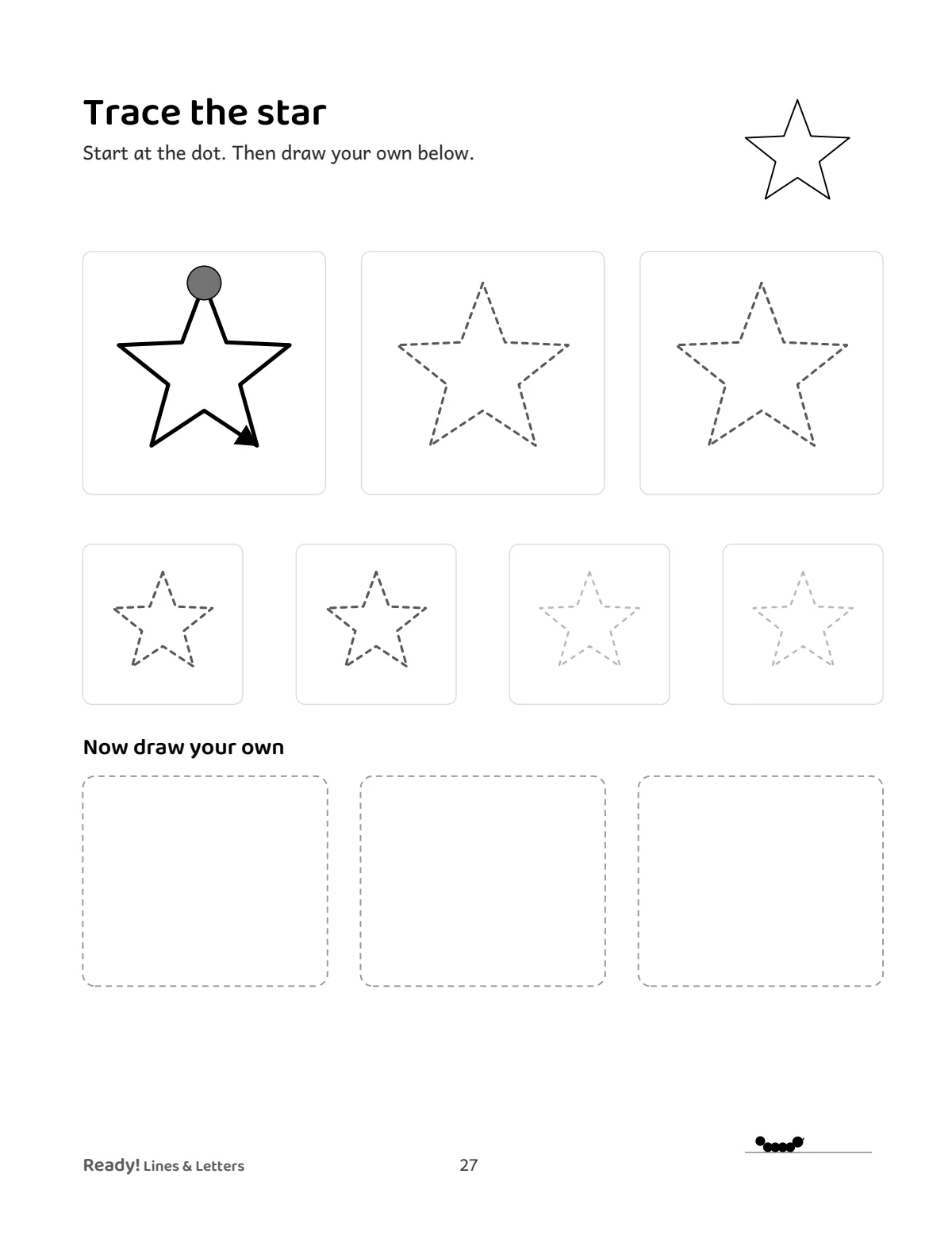
At 3, a child can start drawing lines and shapes on paper with a purpose: a dot to start on, a line to follow, a place to stop. This is tracing, and it is the right kind of tracing at this age, because the goal is control rather than a letter. A page that shows one solid model, then fainter copies, then an empty box, teaches the hand to do more of the work on each try.
At 4, the capitals. Each one should show where to start and which way to go, with a dot and numbered arrows on the model, because a stroke order a child invents is a stroke order a teacher later has to undo. Capitals come before lowercase for a reason: they are made of straight lines and simple curves, they all start at the top, and they are the letters in the name on the child’s coat peg. The order to teach them in, and how long a session should be, is in teaching the letters at home, step by step.
At 5, the lowercase letters and the numbers, in rows a little shorter than the capitals needed, then first words. The row height is not a detail. A young hand makes big letters, so the rows for a 3 year old in our books are three quarters of an inch tall, and a 6 year old’s sentence looks like writing only when the row is about half that.
If your child is not there yet
The range is wide and the floor of it is late. A 4 year old who shows no interest in letters is common, and a parent who pushes at that point usually buys a year of “I hate writing” for a month of progress. Keep the hand busy with the things above and come back to the letters in a few months.
Two things are worth asking about rather than waiting out. A child of 5 who still holds a crayon in a fist, or who cannot copy a line or a circle, may need their hand looked at; a paediatric occupational therapist can tell whether it is a strength problem, a grip habit or nothing at all. And a child who avoids drawing altogether, rather than drawing badly, is telling you something about how it feels in the hand, which is worth hearing before school starts.
Letters that face the wrong way are not on this list. Reversing b and d, or writing an S backwards, is normal in the first years of school, and it fades with practice. Five and six year olds reverse the letters that face left, like d and J, most often (Treiman and colleagues, 2014).
Where to start
If the hand is ready, start with lines before letters, and with letters that show where to start. A book built that way has a grip page first, then pages of lines and curves, then shapes, then the capitals one at a time, in rows a small hand can keep inside, each row fading from a solid model to an empty space so that the child’s own letter ends up on the same line as the example.
If you are choosing a book, the ones a parent meets when searching are set side by side in the best letter tracing books for preschoolers, compared, on the same seven criteria, with every price dated. The short answer there is the same as here: match the book to the hand, not the age on the cover.
Sources
- Centers for Disease Control and Prevention. Milestones by 3 years, 4 years and 5 years. Learn the Signs. Act Early.
- Solihull Children’s Occupational Therapy Service, University Hospitals Birmingham NHS Foundation Trust. Pre-writing skills. The ages for each pre-writing shape, given as a guide only.
- Scharoun, S. M., and Bryden, P. J. (2014). Hand preference, performance abilities, and hand selection in children. Frontiers in Psychology, 5, 82.
- Treiman, R., Gordon, J., Boada, R., Peterson, R. L., and Pennington, B. F. (2014). Statistical learning, letter reversals, and reading. Scientific Studies of Reading, 18(6), 383 to 394.