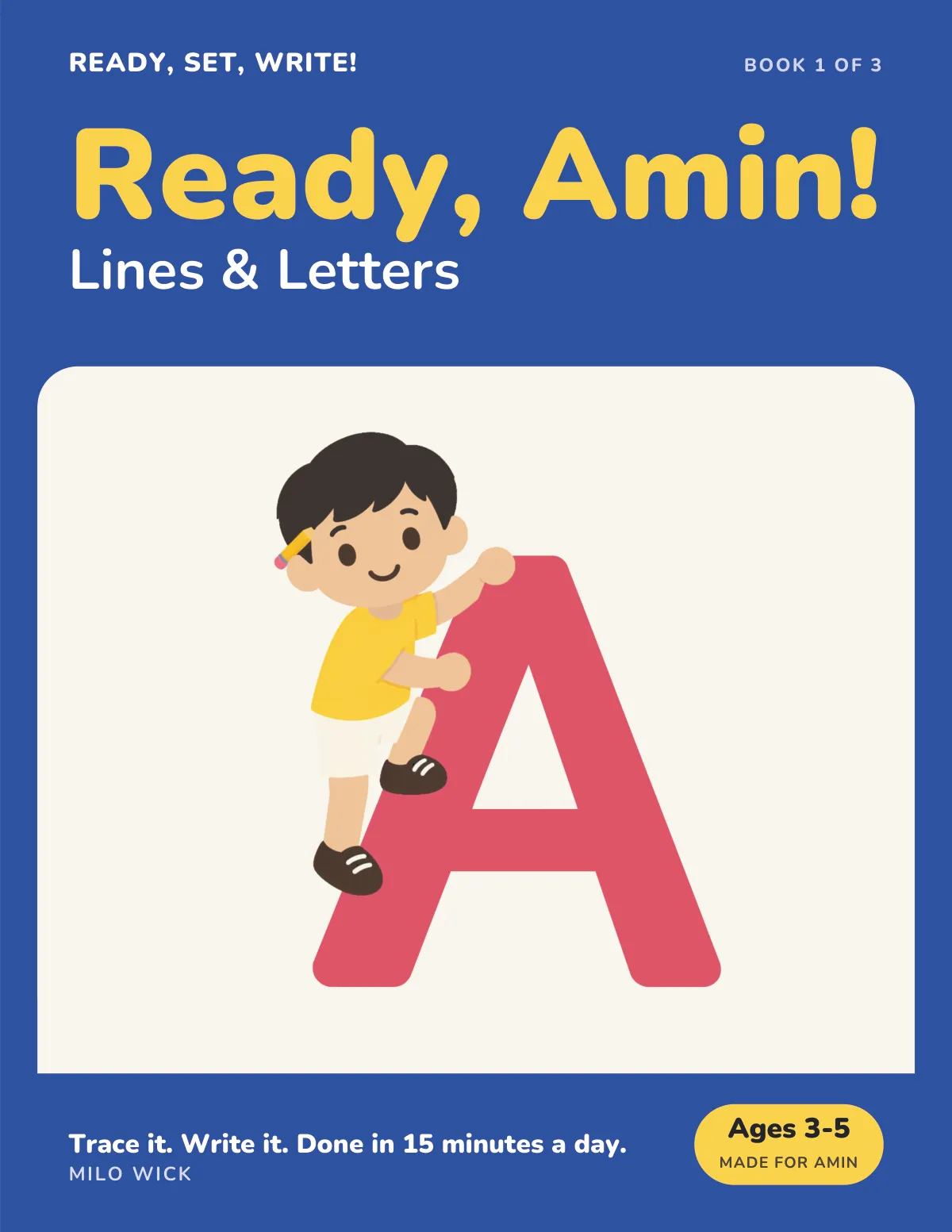
A book with a child's name and face in it is one of the most popular gifts for a young child, and one of the most argued about. The kinds there are, what the research found, the cautions that come with them, and how to tell a good one from a name pasted into a stock story.
What counts as a personalised book
Any book made for one child, with something of that child in it. In practice they come in four kinds, and it helps to know which one you are looking at, because they do different things, and the benefits of personalised books for kids depend on which kind it is.
- Name stories. The child’s name is the plot: each letter of the name is a chapter, an animal or a character, and the book spells the name out across its pages. They are about the name itself.
- Hero stories. A stock story in which the child is the main character, by name, drawn to look like them from a set of looks, or sometimes from a photo. The adventure is the same for every child; the hero is not.
- Alphabet and first-word books. An ABC or a first book of words with the child’s name worked in, often on the page of their initial.
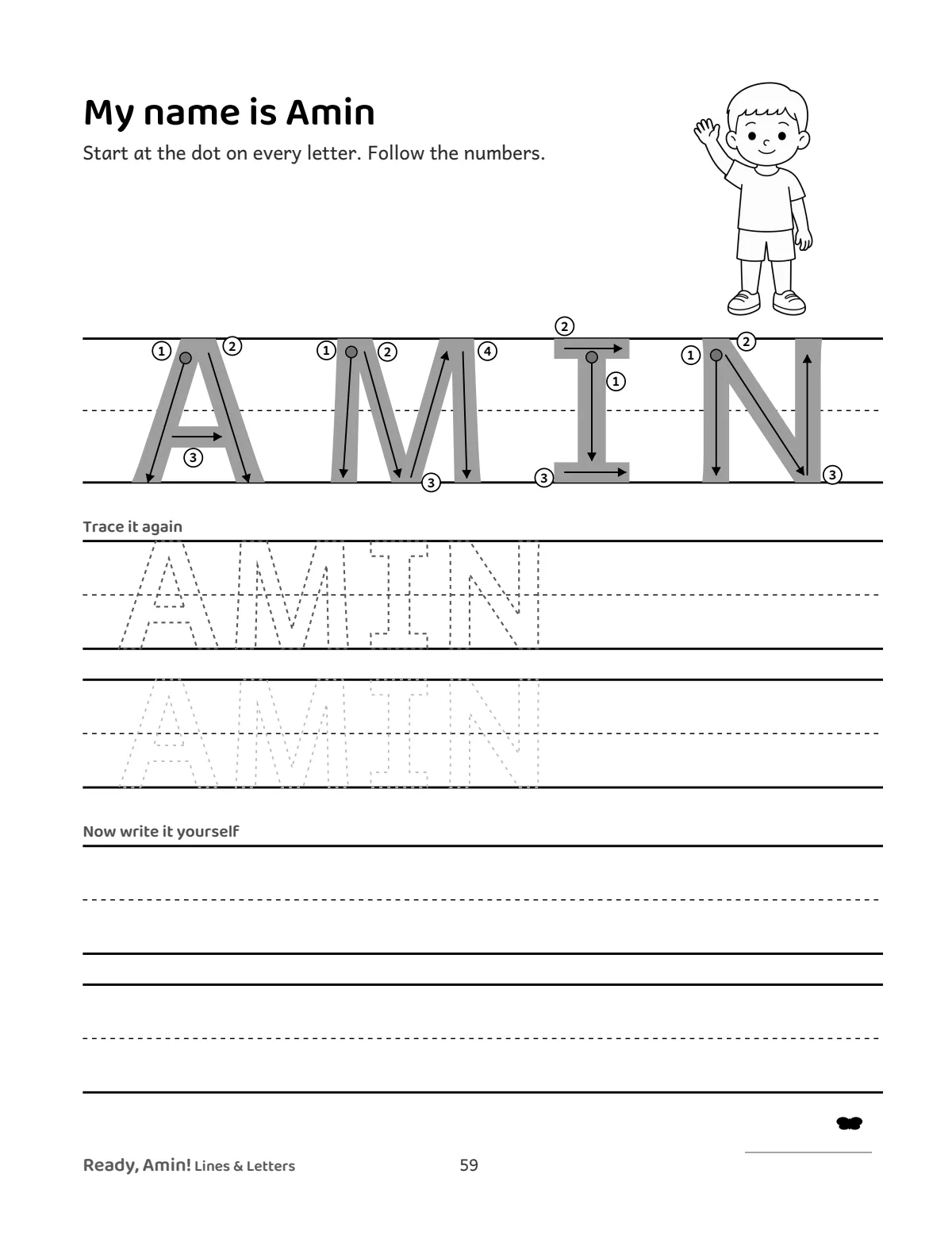
- Workbooks and activity books. A book to write or draw in, with the child’s name used in the exercises: on the cover, on the page of their initial, as the word to trace. Ours is one of these.
A fifth kind barely counts: a generic book with the name printed on the cover or a sticker inside. It is a nice touch and nothing more, and the research below suggests the name alone does very little.
What the research says
Less than the marketing suggests, and more than nothing. Most of it comes from Natalia Kucirkova and her colleagues, and the studies are small:
- Children are more engaged. Toddlers and their parents smiled, laughed and talked more over a personalised book than over a similar plain one, and talked more than over the child’s favourite book (Kucirkova, Messer and Whitelock, 2013, seven families).
- Some new words were learned better. Children of about 4 learned unfamiliar words better from the personalised parts of a printed book than from its plain parts (Kucirkova, Messer and Sheehy, 2014, 18 children).
- But not every time. A digital personalised book showed no difference in word learning (Kucirkova and colleagues, 2021, 26 mothers and their children), and a story with only the child’s name in it did not help children understand its moral (Kruse, Faller and Read, 2021).
The National Literacy Trust’s review of the field calls the evidence promising but “relatively small scale”, and Kucirkova’s own summary is that the studies “are too few for us to know for sure”. Do personalised books help children learn to read? goes through each study, what it compared and what it found.
The firmest evidence near the subject is about the child’s own name, rather than about personalised books: children learn the letters of their name earlier than other letters, and know their own initial best. That is the finding a personalised book can most honestly build on.
Why children love them
Every parent who has given one has seen it: the child finds their name on the cover, then looks for it on every page. A book about them is a book they want to open, and to open again, and in the years when sitting down with a book is a habit still being made, that matters.
There is also something simpler. A young child rarely sees themselves in the books around them: a character with their name, their hair, their glasses. A book where they do says that they belong in books. That is the part of personalisation the research measures least and parents notice most.
When one helps
Putting the studies and the experience together, a personalised book does most when three things are true.
The personalisation does a job. The name is used, not just printed. In a name story, the child learns that their name is made of letters, in order. In an alphabet book, their initial gets its own page. In a workbook, the name is the word they learn to trace and then write. In a hero story, the child’s name and look carry the story, rather than decorating a page that would be the same without them. Ask of any book: what would be lost if the name were taken out? If the answer is nothing, it is a gimmick.
It is read together. Every study in the research had an adult read the book with the child, so sharing it is the only use the evidence covers. A personalised book is an invitation to sit down together, and it pays off only if someone accepts.
It is one book among many. The child should see themselves in some books and other people in most. Kucirkova calls the risk “me, me, me”: a child absorbed in a story about themselves talks about themselves, and a shelf of books about other children is what turns that outward.
When it is a gimmick
- The name is the only change. A stock story with a name dropped in. The child enjoys finding it, and that is the whole effect.
- The story is weak. A personalised book is still a book. If the story would not be worth reading with another child’s name in it, it is not worth reading with your child’s.
- It is for the adult. Some personalised books are really keepsakes for parents: the birth weight, the hospital, the date. Lovely, and not a children’s book.
- It is too young or too old. A story book with long text bought for a 2 year old, or a first ABC for a child of 6, does not become the right book because it has their name in it.
The cautions
Photos and data. Kucirkova raises a point most buyers do not think about: personalised book makers collect children’s data, often a photo and a date of birth, and parents rarely ask what happens to it. Before you upload a photo of your child, read what the maker does with it and for how long. A book drawn from a set of looks needs no photo at all.
Looks are categories. A book that draws your child from a menu of looks puts them in a category: a hair colour, a skin tone, boy or girl. That is how almost every illustrated personalised book works, ours included, and it is a real limit. A child who does not fit the menu is shown as the nearest option. If the look matters to you, see the options before you order.
The self-focus. Already said, worth saying twice: balance it with books about others.
Are they worth it?
A personalised book costs more than a similar ordinary book, often a good deal more, because it is made and printed one copy at a time. Whether that is worth it depends on what it is for.
- As a gift, often yes. It is the gift a child remembers, and the one that is still on the shelf years later. What to write in a book for a child has ideas for the dedication, which is half of what makes it last.
- As a way into reading, partly. Not because the name teaches reading, but because a book a child wants to open gets opened. Read it with them, and use the name for something.
- As a way to learn letters and the name, yes, if it is built for it. This is the use the evidence supports best: the name is the word a child learns first, and its letters the ones they learn first.
- As a replacement for ordinary books, no. One among many.
What to check before you order
- What is personalised. The name only, or the name and the look, or the content? Look at the sample pages, not the cover.
- What the name is used for. Is it a lesson, a plot, or a sticker?
- The age. Does the book suit the child now, not the child next year?
- The looks. If the child is drawn, are there options that resemble them, glasses included if they wear them?
- What they ask for. A first name and a look, or a photo and a date of birth? What is kept, and for how long?
- The proof. Good makers show you the whole book before they print it, so a misspelt name never reaches the child.
- The timing. A book made to order can take two weeks or more. For a birthday, Sinterklaas or Christmas, order early.
Questions parents ask
At what age? They suit the years from about 2 to 6, when a child is learning that their name is a written word and is delighted to find it. Under 2 a book is chewed more than read; over 6 a child is reading books about everyone else, which is the point.
Story book or workbook? A story book is for reading together. A workbook is for doing: tracing, writing, drawing. Many families have one of each. For a child about to start school, a workbook with their name in it teaches the first word they will be asked to write. How to teach a child to write their name has the steps that kind of book follows.
Will a sibling feel left out? Often, yes. A book about one child is a book that is not about the other. Many parents give both children their own, or give the second child theirs on their own birthday.
Does the child need to recognise their name first? No, but it helps them enjoy it. Name recognition activities for preschoolers has twelve ways to get there.
How ours fits
We make personalised copies of two of our handwriting workbooks, each made for one child: Book 1, Ready! Lines & Letters, for 3 to 5 year olds, and Book 2, Set! Letters & Numbers, for 4 to 6. Both are the workbook kind. The name is in the title on the cover, at the foot of every page, on the letter page of the child’s initial, as the word to trace on the practice pages, and on a page that teaches the child to write it. The child in the book is chosen from a set of looks, boys and girls, with or without glasses. We ask for a first name, the look, whether they wear glasses, and a dedication if you want one: no photo and no date of birth. You see a proof of the whole book before it is printed. The rest of the book is the published workbook, the same pages and the same stroke order.
Neither is a story book, and nothing in the research above tested a book like them. What they build on is the name: the first word a child writes, made of the first letters they learn. The personalised book page has the looks, the price and how ordering works.
Sources
- Bloodgood, J. W. (1999). What’s in a name? Children’s name writing and literacy acquisition. Reading Research Quarterly, 34(3), 342 to 367.
- Justice, L. M., Pence, K., Bowles, R. B., and Wiggins, A. (2006). An investigation of four hypotheses concerning the order by which 4-year-old children learn the alphabet letters. Early Childhood Research Quarterly, 21(3), 374 to 389.
- Kruse, E., Faller, I., and Read, K. (2021). Can reading personalized storybooks to children increase their prosocial behavior? Early Childhood Education Journal, 49(2), 273 to 282.
- Kucirkova, N. (2020). Read this before you fall for a personalised book. OpenLearn, The Open University.
- Kucirkova, N. (2021). The educational power (and the limits) of personalized children’s books. Scientific American.
- Kucirkova, N., Gattis, M., Spargo, T. J., Seisdedos de Vega, B., and Flewitt, R. (2021). An empirical investigation of parent-child shared reading of digital personalized books. International Journal of Educational Research, 105, 101710.
- Kucirkova, N., Messer, D., and Sheehy, K. (2014). Reading personalized books with preschool children enhances their word acquisition. First Language, 34(3), 227 to 243.
- Kucirkova, N., Messer, D., and Whitelock, D. (2013). Parents reading with their toddlers: the role of personalization in book engagement. Journal of Early Childhood Literacy, 13(4), 445 to 470.
- Picton, I. (2017). Personalised print books and family literacy outcomes: a literature review. National Literacy Trust.
- Treiman, R., and Broderick, V. (1998). What’s in a name: children’s knowledge about the letters in their own names. Journal of Experimental Child Psychology, 70(2), 97 to 116.