Down, across, slant, round, a curve that turns back, a zigzag. Six movements make every capital letter, and a child who can draw them can write the alphabet. The order they come in, and what to do with each.
Why strokes come before letters
Take the capital letters apart and there are not many pieces. A straight line down. A straight line across. A line that slants. A curve that goes round. A curve that stops and comes back. A line that changes direction sharply. Every one of the twenty-six capitals is some of those pieces, put together in a particular order. Those pieces are the pre-writing strokes, and a preschool child can practise each one long before they write a letter.
A child who has practised the pieces meets a new letter as a small puzzle: two things they can already do, in a new arrangement. A child who has not meets it as two problems at once, the movement and the shape, and gets neither right. This is why a handwriting book that opens on the letter A is making life hard for a 3 year old, and why the first pages of a good one are lines.
The strokes also carry the three habits that make handwriting easy later: start where the dot is, go in one direction, stop where the line stops. A child who has those three by the time they meet a letter has the hard part done.
The six strokes, in order
The order below goes from the easiest movement for a small hand to the hardest. The diagonals come last, between 4 and 5, which is why the letters with slants are the last capitals to come right. One NHS occupational therapy service gives the ages as a guide: down at 2 to 3, across and round at 3, a cross at 4, the two slants at 4 years 4 months and 4 years 7 months, and an X just before 5 (Solihull NHS).
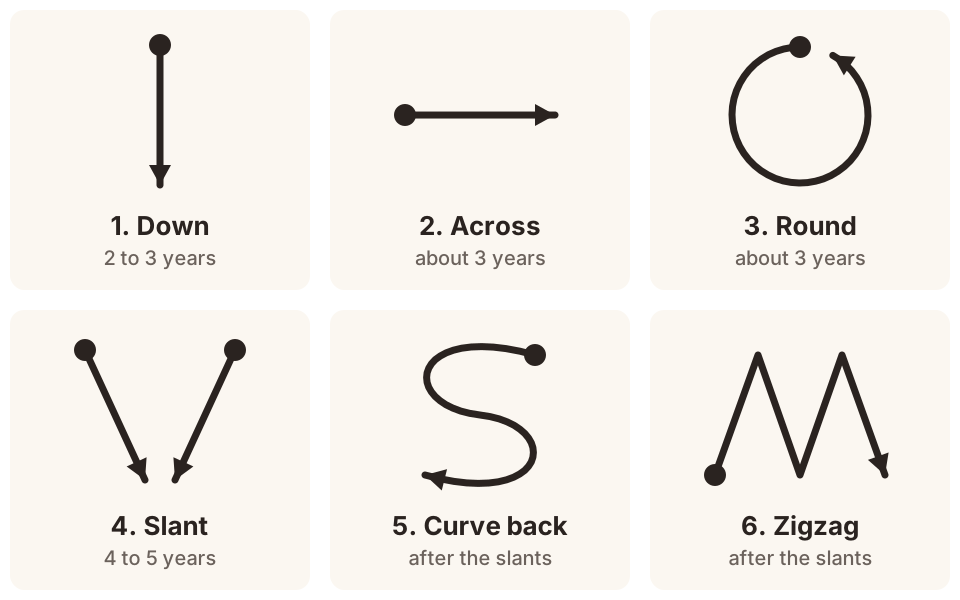
1. Down. A straight line from the top to the bottom. The first controlled mark most children make, and the first stroke of L, T, I, H, E, F, D, P, B and R. Practise it as rain falling, a ladder’s rungs, a flag pole.
2. Across. A straight line from left to right. Left to right matters: it is the direction writing goes, and a child who draws their crosses from right to left will do the same with the bar of a T. Practise it as a road, a fence rail, a plank for a toy to walk along.
3. Round. A circle, drawn anticlockwise from the top, which is how O, C, G and Q are formed and how the round part of a, d and g will be formed later. The hard part of a circle is coming back to where it started. Practise it as a wheel, a ball, a plate, a face, and always from the top.
4. Slant. A diagonal, down to the right and down to the left. Diagonals need the wrist and the fingers to work together, which is why they come late; a 3 year old’s slant is often a wobbly vertical. Practise them as a slide, a tent, rain in the wind, and then as a cross with two slants, which is an X.
5. Curve back. A curve that goes round and then turns the other way: the S, the top of a J, the hooks of the 2 and the 5. The hardest movement on the list, because the hand has to change its mind halfway. Practise it as a snake, a wave, a hook, a swan’s neck.
6. Zigzag. Lines that change direction sharply without lifting the pencil: M, N, W, Z. A zigzag is several slants joined, so it comes after the slant and tests it. Practise it as mountains, a crown, teeth, lightning.
On paper: dot, direction, stop
A stroke page for a 3 year old needs three things on it, and most worksheets have one.
The first is a dot where the stroke starts. Not a faint line to find the beginning of; a dot, large enough to put a pencil on. The child learns to look for the dot, and later every letter will have one.
The second is the direction, shown. For a single stroke that is an arrow at the end of the model line; for a curve, an arrow along it. The child traces the model with the arrow and then draws the stroke on the lines below it.
The third is a place to stop: the end of the line, the edge of the road, the picture at the end of the path. Stopping is a skill. A pencil that keeps going past the end of an L becomes a pencil that does not know where the letter finishes.
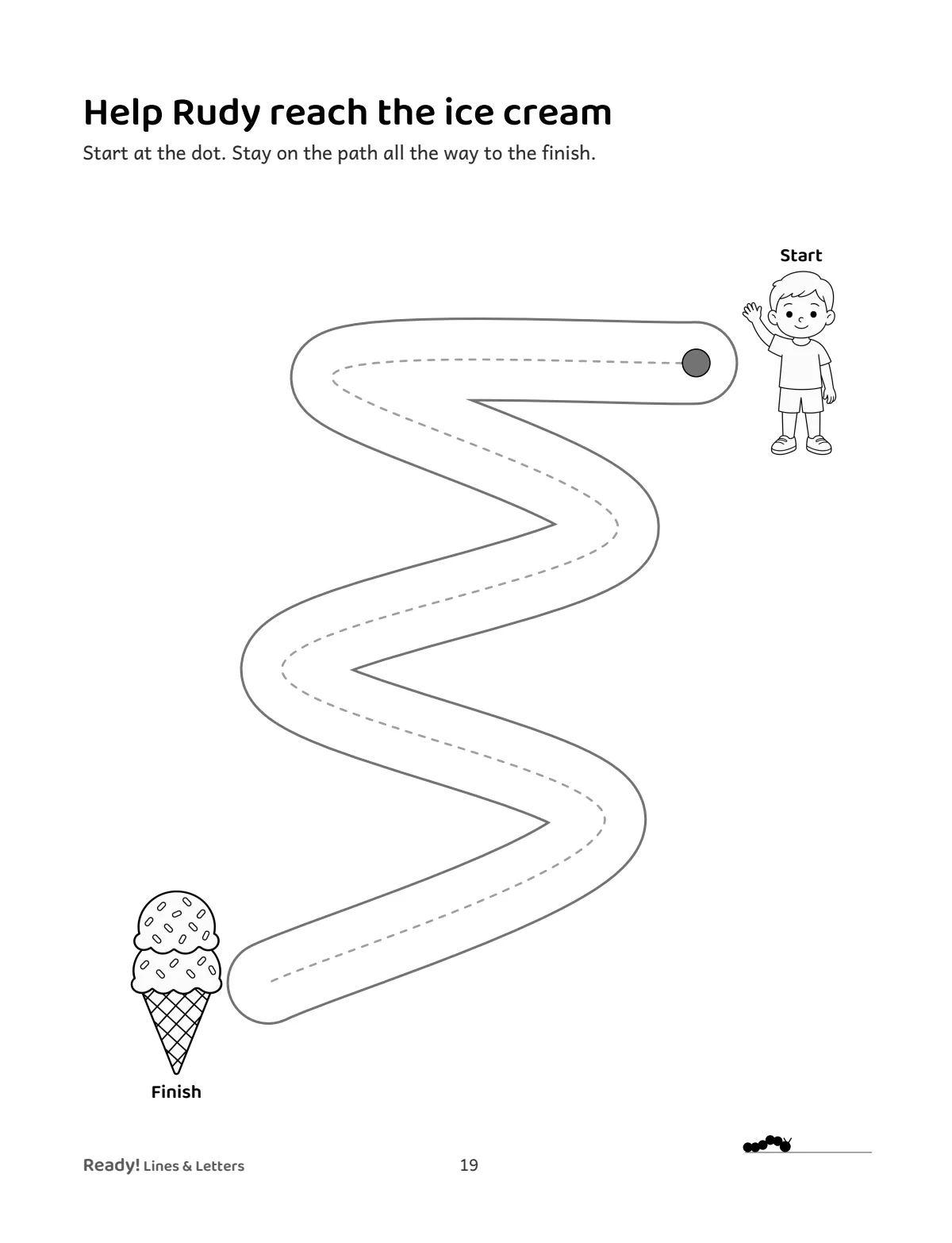
Paths and mazes are stroke pages in disguise, and children prefer them. A road that winds from a dot to a house is a long down-across-round-slant with a reason to stay inside the lines, and a maze adds choosing a direction. Two or three of these between the straight strokes keep a 3 year old at the table.
A page of strokes should also fade, as a letter page does: a solid model to trace, then dotted copies, then a faint one, then a blank. The hand should do a little more of the work on each try, and the fourth stroke on the row is the child’s own. Is tracing good for learning to write? says why that step between tracing and writing is the one that matters.
Off paper: the same strokes, larger
The movements are easier to learn big than small, because a big movement comes from the shoulder and the arm, which a 3 year old controls well, and a small one from the fingers, which they do not yet. So for every stroke on paper there should be the same stroke somewhere else, larger.
Chalk on a wall or the pavement. A paintbrush and a pot of water on a fence. A finger in sand, salt on a tray, shaving foam on the table. A ribbon on a stick drawing circles in the air. The stroke drawn in the air with the whole arm, with the child saying its name. None of this needs buying, and all of it is handwriting practice.
The hand itself needs strengthening too, and that is separate from the strokes. Playdough squeezed, rolled and pinched. Beads threaded. Pegs clipped on a line. Scissors, under supervision, cutting along a line. Tweezers picking up pompoms. A child who does these for ten minutes a day will hold a pencil better in a month than one who does worksheets for the same ten minutes.
How long to spend here
With a 3 year old, expect two to four weeks of a few minutes a day before the strokes are reliable, and do not hurry it: every week spent here is a week saved on letters. With a 4 year old who already draws, a week may do. The signs that it is time to move on are the three habits: the pencil starts on the dot, goes one way, and stops at the end. When those are there for a straight line and a circle, the child is ready for shapes, and a child who can copy a circle, a cross and a square is ready for the first letters. The cross usually comes at about 4 and the square at about 4 and a half (Solihull NHS), so a 3 year old can start on the letters made of straight lines before the square is quite there.
If that is not yet where your child is, when do children learn to write letters? says what comes first and what readiness looks like. And when it is, how to teach a preschooler to write letters picks up exactly here, at step 2.
What a book should do with this
A handwriting book for 3 to 5 year olds should spend its first pages on these strokes, in roughly this order, each with a dot, an arrow and a reason, and should put a few paths and mazes between them. It should not open on the alphabet, and it should not give the strokes two pages and the letters forty. The ratio in the first book of the series this site is about is sixteen stroke pages, four mazes and six shapes before the first capital, which is about a third of the book, and about the share of the year a 3 year old spends on them.
The best letter tracing books for preschoolers, compared lists, for eight books, whether they teach strokes before letters, and how much of the book they give it.
Sources
- Solihull Children’s Occupational Therapy Service, University Hospitals Birmingham NHS Foundation Trust. Pre-writing skills. The ages for each pre-writing shape, given as a guide only.